
Why central kitchens exist
A central kitchen prepares what several outlets need: gravies, marinades, dough, sauces, cut vegetables. The outlets then finish and serve. This gives the same taste in every outlet and saves prep time in each one.
The cost is the movement of goods. If you do not control it, food goes missing between the central kitchen and the outlets.
The four steps
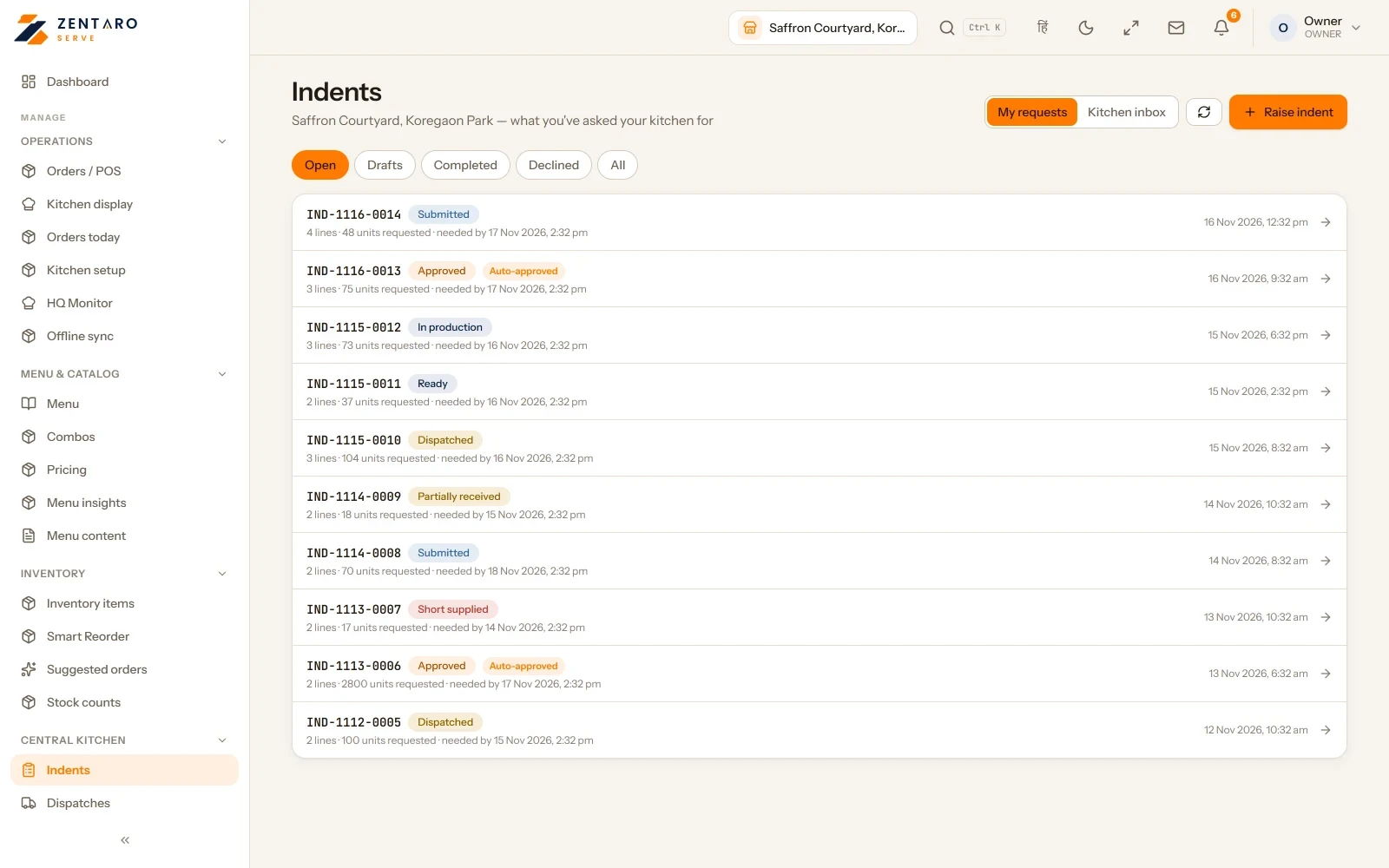
- Indent. The outlet lists what it needs and by when.
- Dispatch. The central kitchen packs the goods and sends them with a challan listing what was sent.
- Receive. The outlet counts the goods and compares them with the challan.
- Close. Any difference is noted, and the indent is marked complete.
The words matter. An indent is a request. A challan is the delivery slip. A transfer is the movement of stock from one place to another, from the central kitchen to the outlet.
One tax point: if your outlets hold separate GST registrations, a transfer between them is treated as a supply and needs a tax invoice, not only a challan. Ask your accountant which applies to you.
How an outlet decides the quantity
A simple rule: the outlet asks for its par level minus what is on hand.
Indent quantity = par level - stock on hand
Par is the stock you want after a delivery. See how to set par level. The outlet also adds a note for any event or festival coming.
Cut-off times
The central kitchen needs time to prepare. Set a cut-off. For example, indents for tomorrow close at 6 pm today. An indent after the cut-off needs a special approval. Without a cut-off, the kitchen cooks at midnight for a late request.
Example: three outlets, one kitchen
This is an example, with made-up numbers. The central kitchen makes a chicken gravy base. Today it has 70 kg ready. Three outlets send indents.
| Outlet | Par | On hand | Indent |
|---|---|---|---|
| Outlet A | 40 kg | 10 kg | 30 kg |
| Outlet B | 30 kg | 5 kg | 25 kg |
| Outlet C | 45 kg | 10 kg | 35 kg |
| Total | 90 kg |
The indents total 90 kg, but only 70 kg is ready. The kitchen is short by 20 kg. Here is a fair rule that does not depend on who shouted loudest: share the 70 kg in proportion to each indent.
| Outlet | Indent | Share of 90 | Dispatch |
|---|---|---|---|
| Outlet A | 30 kg | 33.3 percent | 23.3 kg |
| Outlet B | 25 kg | 27.8 percent | 19.4 kg |
| Outlet C | 35 kg | 38.9 percent | 27.2 kg |
| Total | 90 kg | 69.9 kg, about 70 |
Another rule is to serve the outlet with the lowest stock first. Pick one and tell the outlet managers, so a short supply does not become an argument. Record the shortfall on each indent. Mark the missing 20 kg as pending, so the next batch fills it first.
Receive and check
When the goods arrive, the outlet counts or weighs them in front of the driver, if possible.
- Compare with the challan, line by line.
- Note any shortage, damage or late arrival on the spot.
- Do not accept goods that are warm or look spoiled. Write the reason.
- Close the indent. Only then does the outlet's stock go up.
Suppose Outlet B receives 18.9 kg against a challan of 19.4 kg. The difference of 0.5 kg is within normal weighing and spill loss for this item. If the gap were 3 kg, the manager would raise it the same day.
What to track
- Indents raised, dispatched and received, per outlet.
- Shortfalls and who they hit.
- Gaps between challan and receipt.
- Cost of goods sent, so each outlet's food cost includes it.
Common questions
What is an indent?
An indent is a request from an outlet to a central kitchen or store for goods.
What is a challan?
A challan is the delivery slip that lists what the central kitchen sent.
What if the central kitchen cannot fill every indent?
Use a fixed rule, such as sharing in proportion to each indent, and record the shortfall as pending.
Why set a cut-off time?
The central kitchen needs time to prepare. A cut-off stops late requests from forcing night work.
How do I find missing goods?
Compare the challan with what the outlet received, line by line, on the day of delivery.
Where Zentaro Serve fits
In Zentaro Serve, outlets send indents, and the central kitchen dispatches against them with a challan. It is licensed separately.
See central kitchen software