What par level means
Par is a target. It is the level you refill to. When a delivery comes, you top the shelf up to par. If you are below par, you order the difference.
Some people use the words par stock, reorder level and safety stock as if they were the same. They are related, but not the same. Here are the differences.
| Term | Meaning |
|---|---|
| Par level | The amount you want after a delivery, the top of the shelf |
| Reorder level | The amount at which you place an order, a trigger |
| Safety stock | Extra kept in case of a late delivery or a busy day |
| Lead time | Days between ordering and receiving |
A restaurant that orders on fixed days uses par. A restaurant that orders when stock drops uses a reorder level. Many use both. See the reorder point calculator for the second method.
What you need to know first
You need four numbers for each item.
- Daily use. How much do you use on an average day? Take it from your stock register, or count use for two weeks.
- Delivery days. How many days must one delivery cover? If the vendor comes every second day, it is two. If he comes only on Monday and Thursday, the gaps are three and four days. Use the longest gap.
- Lead time. How long between you placing an order and the delivery? Some are same-day, some two days.
- Safety buffer. How much extra will you carry for busy days or a missed delivery?
If your use jumps at weekends, work out a weekday number and a weekend number. Use the higher one for the days that matter.
The formula
Par level = (daily use × days to cover) + safety stock
Days to cover is the gap between deliveries, plus lead time if you order ahead of the delivery. Safety stock is a small cushion, often a fraction of one day's use. Choose it by how costly a stock-out is. Running out of onions is costly. Running out of a rarely used spice is not.
Example: par level for onions
This is an example with made-up numbers. A kitchen uses about 12 kg of onions a day. The vendor delivers every second day. The kitchen wants a safety buffer of half a day's use.
| Step | Working | Result |
|---|---|---|
| Daily use | From two weeks of records | 12 kg |
| Days to cover | Delivery every 2 days | 2 days |
| Use between deliveries | 12 × 2 | 24 kg |
| Safety buffer | Half a day, 12 × 0.5 | 6 kg |
| Par level | 24 + 6 | 30 kg |
When the vendor arrives, the stock is 7 kg. The order is 30 minus 7, which is 23 kg. If the stock were 20 kg, the order would be 10 kg.
On weekends, the kitchen uses about 18 kg a day. For a Friday delivery that must cover Saturday and Sunday, the par would be 18 × 2 plus a buffer of 9 kg, which is 45 kg. So the kitchen might use two par levels: a weekday one and a weekend one.
Different items need different pars
Not all items behave the same.
- Fresh vegetables and dairy spoil. Keep par low and deliveries frequent.
- Rice, flour, pulses and oil keep well. Par can be higher, with fewer orders, if you have space and cash.
- Gas needs a spare cylinder. Par is often one full spare.
- Packaged items can be high or low, depending on vendor minimum orders.
For perishable items, a par that is too high leads to waste. For dry goods, a par that is too high ties up cash. A par that is too low leads to stock-outs and rushed buying at a higher rate.
How to use pars each week
- Print a par sheet with each item, its unit and par.
- Do a count before the order day.
- Write the count next to the par.
- Order par minus count.
- Round up to the pack size the vendor sells.
- Review the pars each month, or when your menu or sales change.
The stock register is the natural place to keep these numbers.
Common mistakes
- Setting a par once and never changing it.
- Ignoring weekends and festivals.
- Using the same safety buffer for every item.
- Forgetting lead time.
- Counting stock while the kitchen is busy.
- Setting par by feel, with no use data.
A short checklist
- Do I know daily use for my top 15 items?
- Is the delivery gap clear for each vendor?
- Have I included lead time and a safety buffer?
- Do I have a separate weekend par where use changes?
- Do I review the pars each month?
Common questions
What is a par level in a kitchen?
It is the amount of an item you want on the shelf after a delivery. You order the difference between par and your count.
How is par different from reorder level?
Par is the top you refill to. Reorder level is the point at which you place an order.
How do I find daily use?
Take it from your stock register, or count use daily for two weeks and average it.
What is safety stock?
It is extra kept for a late delivery or a busy day. Set it by how costly a stock-out would be.
How often should I change par levels?
Check monthly, and when your menu, sales or vendor schedule changes.
Do I need different pars for weekends?
If your weekend use is much higher, yes. Use a weekday par and a weekend par.
Where Zentaro Serve fits
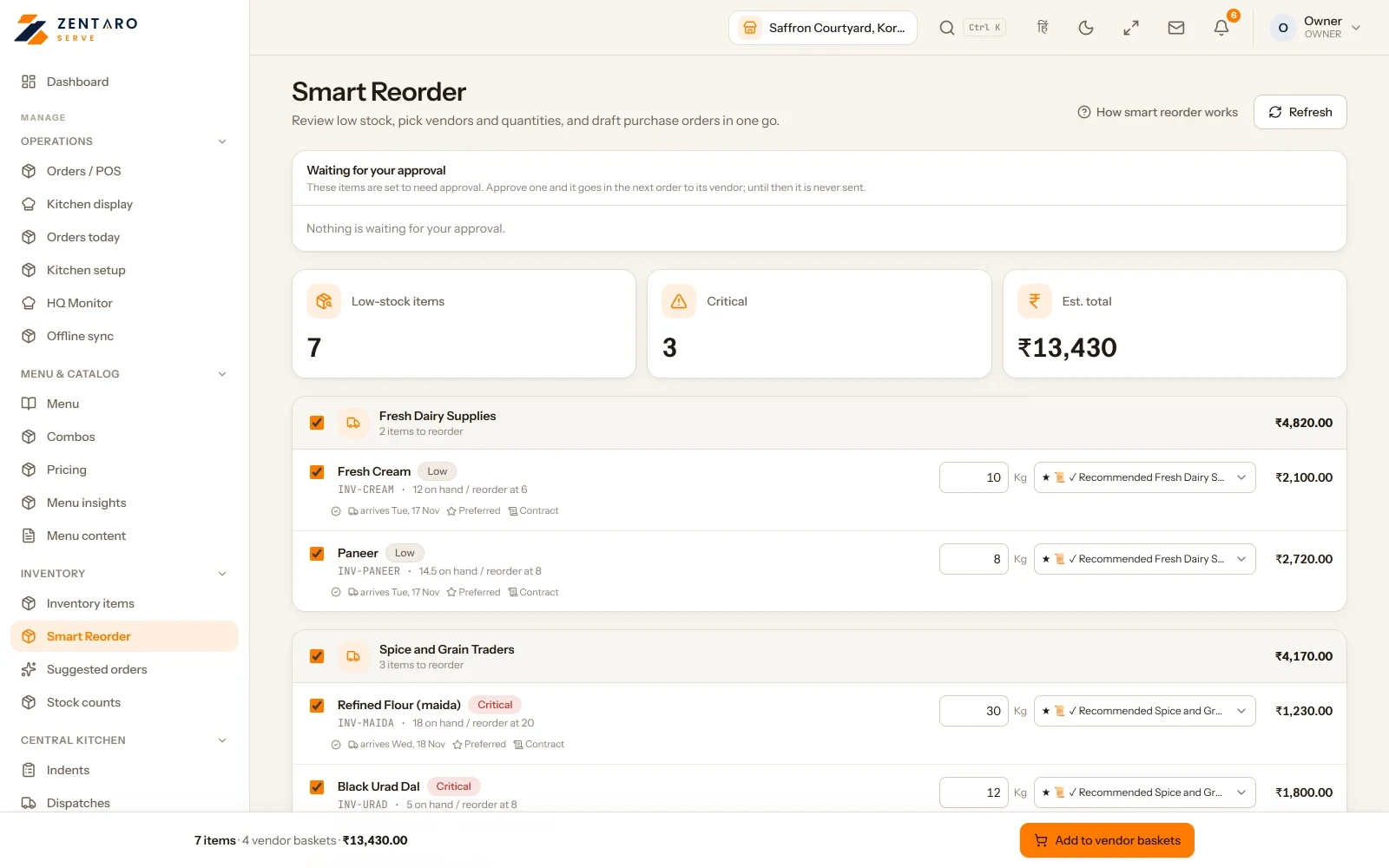
In Zentaro Serve, stock levels fall as dishes are sold, and the software suggests what to reorder and lets you compare suppliers.
See inventory software