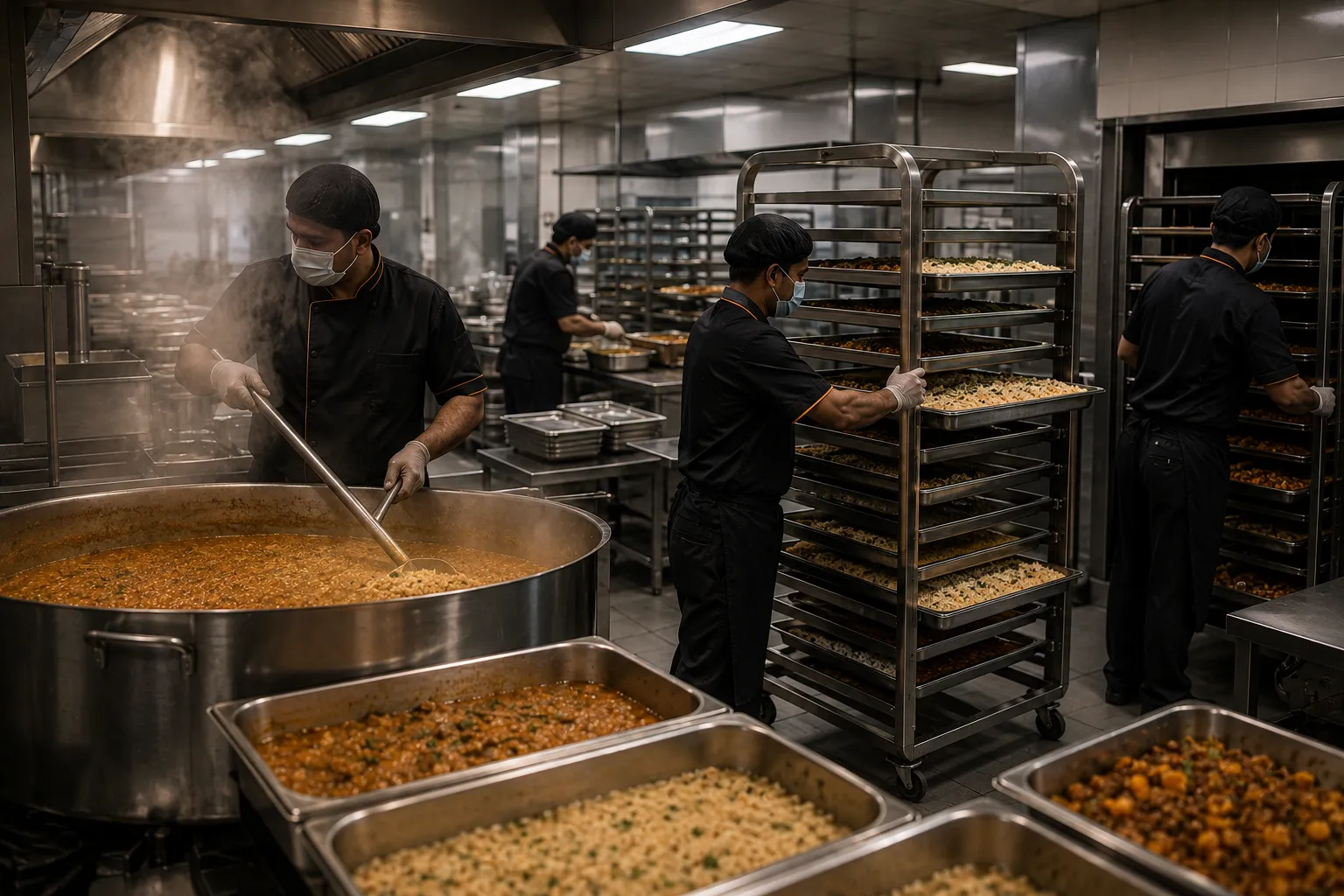
A production kitchen cooking at batch scale: a chef working a large pot, trays of finished food loading onto a transport rack.
Central kitchen

Central kitchen software: one kitchen feeding many

Central kitchen software runs a commissary that cooks for several outlets. In Zentaro Serve, outlets raise indents, the hub plans and cooks, goods go out with a dispatch and challan, and the outlet receives them. Every batch is checked from made to sold, so stock does not go missing twice.

  • An indent, not a phone call
  • Dispatch with a challan
  • One row for each batch
  • A batch cannot go over plan unseen

Without it

  • Outlets ask for stock on a phone call, and nobody can reconstruct who asked for what.
  • Goods move between locations with no challan, which is a compliance problem before it is an accounting one.
  • The kitchen makes 80% over plan and the only evidence is the food.

What it does.

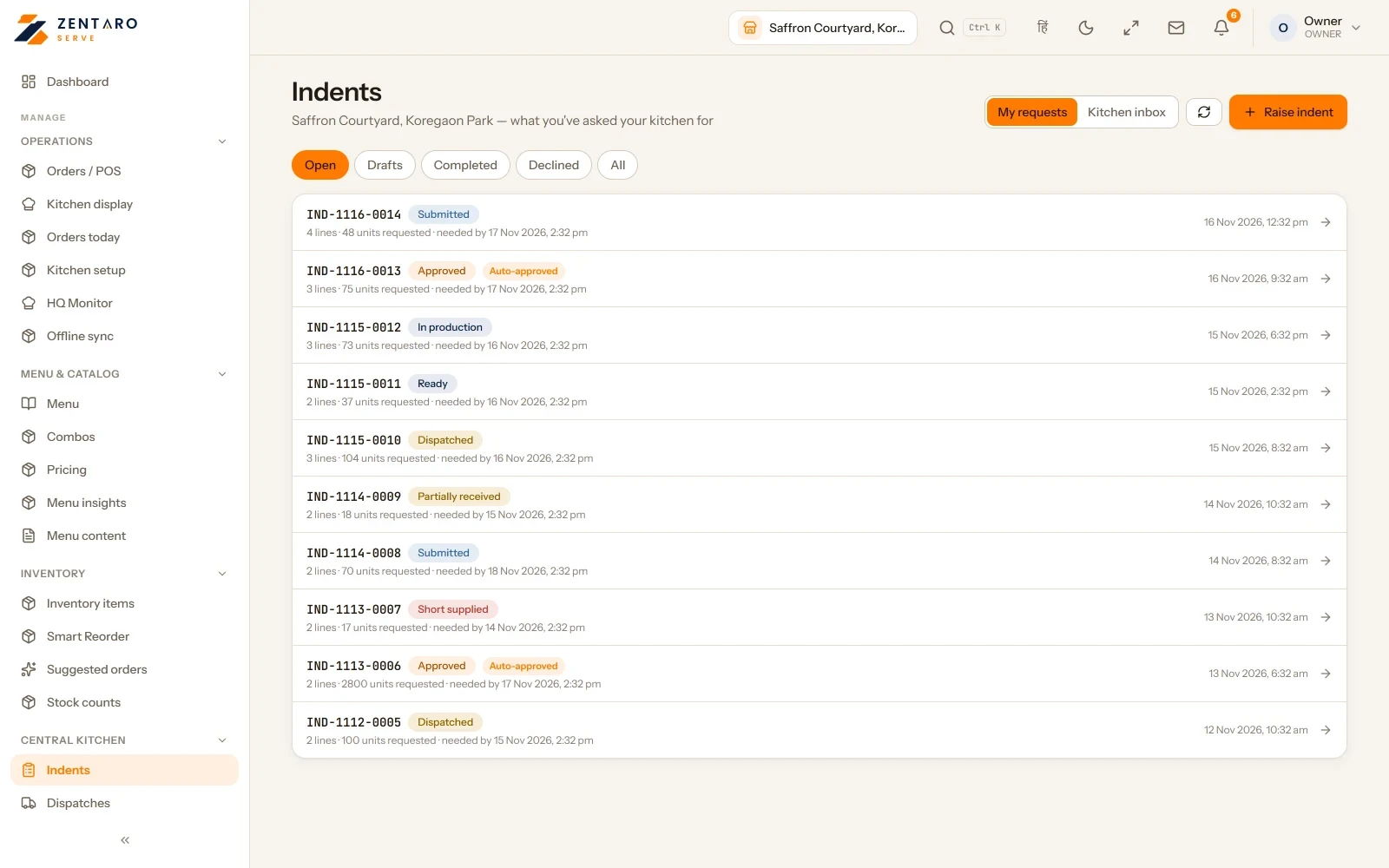
An indent, not a phone call

An outlet asks for goods with a document. It has a date and a name. Restocking does not depend on who remembered to ring.

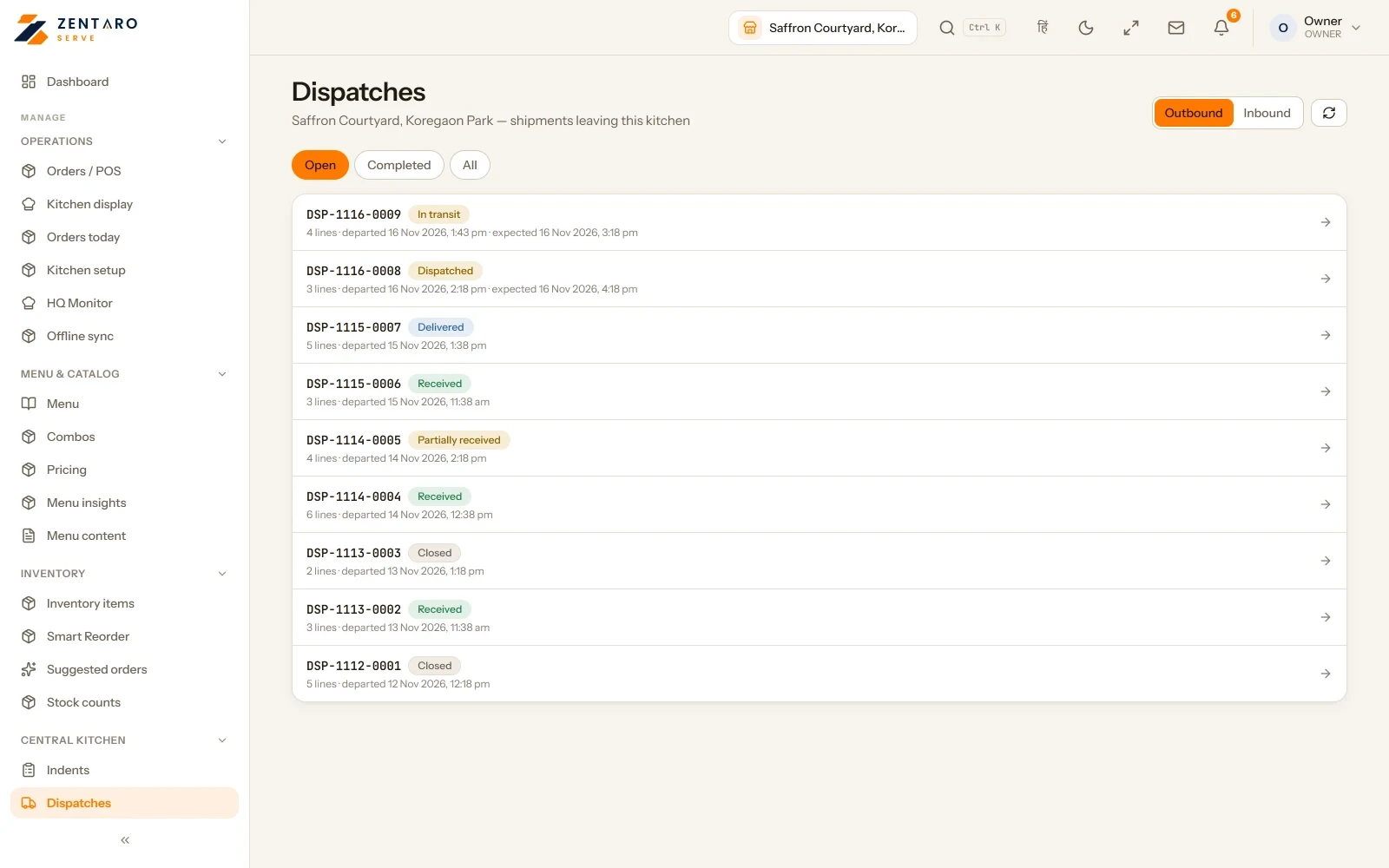
Dispatch with a challan

Goods leaving the hub travel with a delivery challan. Moves between your own locations carry the paperwork the move needs.

One row for each batch

Made, sent, received and sold are joined in one row. Missing stock, double counts and unposted waste each show up in a different place.

A batch cannot go over plan unseen

Making more than planned is refused unless someone overrides it. The override is recorded.

Receiving adds up

Partial deliveries add up without clashing. The outlet gets real lots, so it can use the oldest first.

Write-offs need two people

Stock value cannot leave the hub on one signature. This is the same rule as at the till.

A production site, not a shop

The hub is kept separate. Shop screens and till features do not appear in a kitchen that never serves guests.

Cook to demand

Production follows what the outlets asked for. It is not a fixed number nobody checks.

The system suggests, a person agrees

Zentaro Serve works out the split across outlets and stops. Stock moves only when someone agrees. If you dismiss it, nothing moves.

How it works.

Outlet sends an indentyour team

It says what is needed, when, and who asked.

The hub cooks to itautomated

Planned from real demand, not a guess.

Sent with a challanautomated

The move between your own locations is on paper.

Outlet receives the lotsautomated

Partial deliveries add up. The shop can use the oldest first.

The batch is checkedautomated

Made, sent, received and sold sit in one row.

Try it.

One batch of gravy

Planned 100 kg for three outlets. Step through the legs and watch the row close — or not.

Batch CK-4417 · Gravy base31 Aug
    Unaccounted—

    Nothing has been produced yet.

    Product screens

    The screens you and your team will use for this.

    Indents from outlets
    Dispatch and challans

    Example screens with sample data

    The problem you know

    Why a commissary loses track of food

    • Outlets ask for stock on a phone call, and nobody can say who asked for what.
    • Food travels between locations with no paper.
    • The hub makes too much, and the only proof is the leftovers.

    How do indents and dispatch work with a commissary?

    1. An outlet raises an indent: what it needs and by when. Auto-indent can raise one from stock levels.
    2. The hub plans its day from the indents.
    3. Goods leave with a dispatch and a challan. The challan register keeps the papers.
    4. The outlet receives the goods and notes any shortage or damage, with evidence.
    5. Cold chain and transfer tax are recorded on the move.
    6. The batch is checked from made to sold, with the food cost of the run.

    What central kitchen software includes

    • Supply routes: which hub feeds which outlet. A route is closed with a reason.
    • Receipt evidence and resolutions when a delivery is short.
    • A write-off needs a second person to approve it.
    • Each kitchen works to its own local date.

    What it is not

    • Central kitchen is licensed separately. It does not use one of your outlets.
    • A production batch above the plan is refused unless the manager records a reason.
    • It is a making site. Guests are not served from it.

    Who uses the central kitchen system

    Who it is for

    • Head office: sees made, sent and sold.
    • Hub head chef: plans from indents.
    • Outlet manager: raises and receives.

    Talk to us and tell us your hub and the outlets it feeds. Talk to us

    Costed runs, quality checks and batches

    Production runs with a cost

    • Raise a run for what a kitchen is making today. A run on a recipe is scaled and costed from its ingredients.
    • A run with no recipe is recorded but not valued.
    • You can pause or reject a run. Good plus rejected cannot be more than what was made.

    Quality check before dispatch

    • Turn on QC and every batch waits for a person to release it.
    • Set a range for each measurement, such as a weight or a temperature. Blocking checks hold the lot; advisory ones are only recorded.
    • The system decides pass or fail from the number you set.

    Machines, stages and the stage board

    • Add the ovens, mixers and benches a batch waits for, and how much each holds in one cycle.
    • Set the stages of a workflow in order. See where each batch is now.
    • Ingredients are taken from stock at one stage only, so they are never counted twice.
    • It needs the production engine switched on for your account.

    Shelf life and first-expiring-first-out

    • Set three windows for each product: full price, markdown and expiry.
    • They are fixed onto each batch when it is made. A later change cannot rewrite a batch already cooked.
    • A pick preview shows which batch comes first. It takes nothing.

    Hold ingredients for a run

    • A run keeps back the ingredients it needs before it starts.
    • The screen shows what is held, what was released and what is free for another order.
    • A hold has its own deadline. After it, the stock goes back to the pool.

    Delivery challan and tax invoice

    • A dispatch can carry a delivery challan or a tax invoice, with the GSTIN at both ends.
    • The challan register lists them.

    Common questions.

    What is an indent?

    An indent is a request from an outlet to the central kitchen for what it needs.

    How does food travel between locations?

    It is dispatched on a challan. The outlet receives it and the batch is checked from made to sold.

    What is central kitchen software?

    It is software for a commissary that cooks for several outlets. Outlets send indents, the hub cooks, goods go out with a challan and the outlet receives them.

    What is an indent in a restaurant chain?

    An indent is a request from an outlet to the central kitchen for what it needs. It carries a date and the name of who asked.

    How do I track food sent from a commissary to outlets?

    Goods are dispatched with a challan, and the outlet receives them. Each batch is then checked from made to sold.

    Can one central kitchen supply several brands?

    Yes. A central kitchen can supply more than one brand.
    Tell us about your restaurant.

    Zentaro Serve launches in 2027. Tell us what you run today and we will get in touch.

    Talk to us Join the early access list

    Last updated:

    Pricing is coming soon

    We are keeping pricing simple. We will share it when Zentaro Serve launches in 2027. Join early access and we will tell you first.