
Who owns what
| Item | Company-owned outlet | Franchise outlet |
|---|---|---|
| Owner of the business | Head office | The franchisee |
| Staff employed by | Head office | The franchisee |
| Money in the till belongs to | Head office | The franchisee |
| Menu and prices | Set by head office | Set by head office, often within rules |
| Brand standards | Enforced by head office | Set in a contract and checked |
Ownership decides what each side has a right to see. Always read the contract with a lawyer. This article is about operations, not law.
What head office needs from a franchise
Head office needs enough to protect the brand and check the contract.
- Sales by day, so any fee linked to sales can be worked out.
- Whether the standard menu is being sold, and at the right prices.
- Quality signals: ratings, complaints, wastage and food cost.
- Whether the outlet follows brand rules, such as opening hours.
A royalty is a fee a franchisee pays the brand, usually linked to sales. The rate, the base and the date are in the contract, so they are not described here. What matters for reports is that sales must be counted the same way for every outlet.
What the franchisee needs
The franchisee needs their own full picture: daily sales, costs, staff, cash and profit. Head office may not need the franchisee's staff costs or personal cash. Give each side the views it needs and no more.
What stays the same
Some reports are the same for both:
- Sales by item, by hour and by channel.
- Voids and discounts.
- Food cost and wastage.
- A standard menu, so the same dish has the same name and recipe in every outlet.
A standard menu is the key. If every outlet names the dish differently, you cannot compare them.
Example: two outlets, four numbers
This is an example, with made-up numbers. Outlet 1 is company-owned. Outlet 2 is a franchise. Both are compared on the same four numbers for one week.
| Number | Outlet 1 (company) | Outlet 2 (franchise) |
|---|---|---|
| Sales | 420,000 | 380,000 |
| Food cost | 31 percent | 36 percent |
| Voids and discounts, share of sales | 2.0 percent | 4.5 percent |
| Average bill | 310 | 290 |
Outlet 2 sells less, which is not surprising. The other numbers are the useful part. Food cost is five points higher. Voids and discounts are more than twice as high. This is the outlet comparison. It does not say who is to blame.
Next questions: is Outlet 2 giving away discounts that the brand does not allow? Is its food cost higher because of portions, or because it buys at different prices? For a franchise, the head office asks. For the company outlet, the head office acts. The same report starts two different conversations.
Control without friction
Control in a franchise comes from clear rules and shared data, not from daily checks.
- Agree the standard menu and price list, and who may change them.
- Agree the reports head office receives, and when.
- Agree what happens when the numbers drift.
- Review together on a fixed schedule, such as monthly.
Surprise checks cause friction. A shared report that both sides read the same way does not.
Setting it up
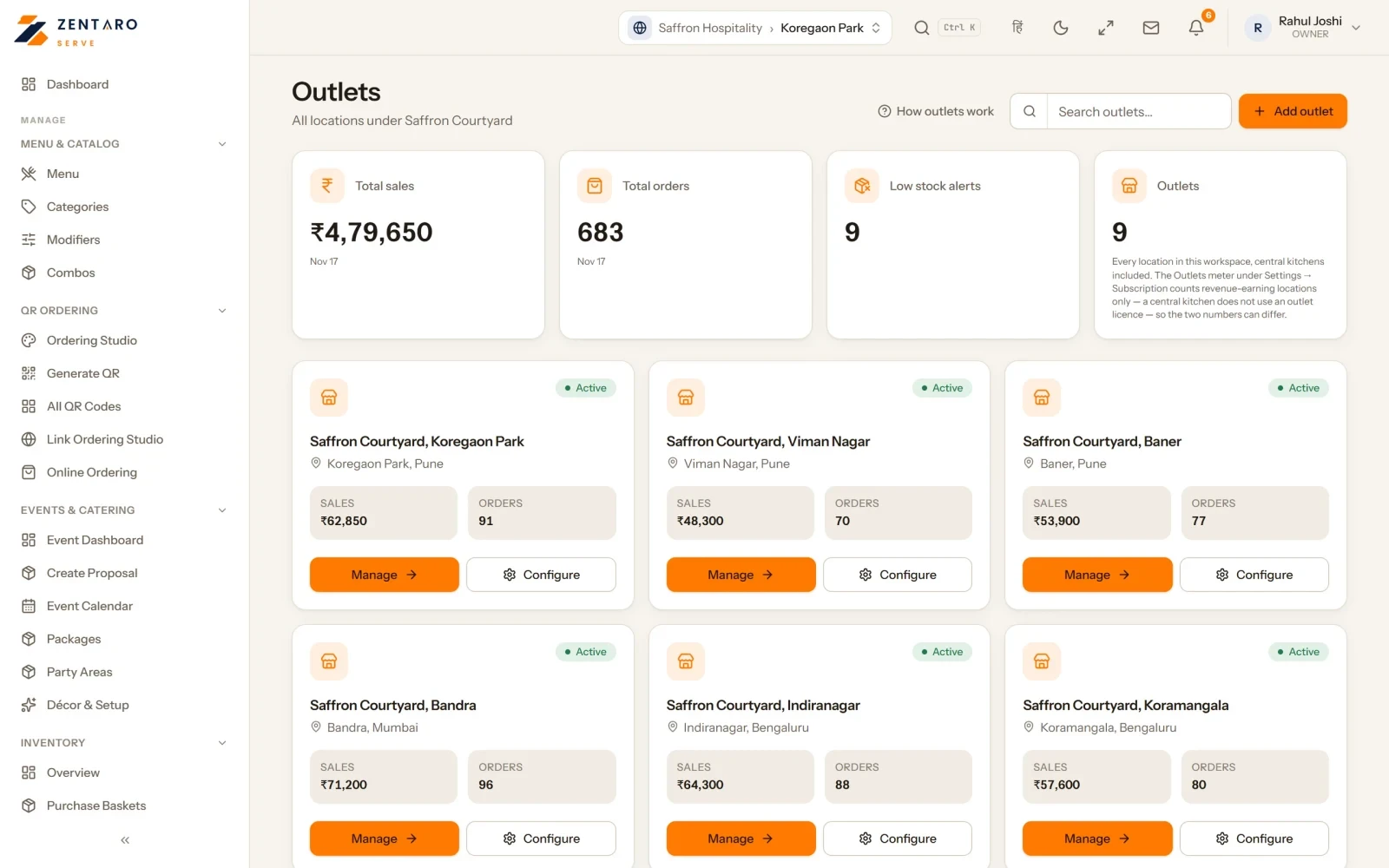
Your software should let you give each role the view it needs. In a franchise set-up, head office would see all outlets, and each franchisee would normally see only the reports of their own outlet. In Zentaro Serve today, a regional manager sees only their own region. Franchise features are planned, not built: see the franchise group on the roadmap.
Common questions
What changes in reporting for a franchise?
Who may see what. Head office needs sales, menu and quality data. The franchisee keeps a full private view of their own business.
What is a royalty?
A fee a franchisee pays the brand, usually linked to sales. The terms are set in the contract.
Why do I need a standard menu?
It gives every dish the same name and recipe in every outlet, so reports can be compared.
What is an outlet comparison?
A report that sets outlets side by side on the same numbers, such as sales, food cost, voids and average bill.
Does a franchise need different software from a company outlet?
It needs the same reports, with roles that control who sees what.
Where Zentaro Serve fits
In Zentaro Serve, one company can hold brands, regions and outlets. A region manager sees and changes only their own regions.
See multi-outlet software