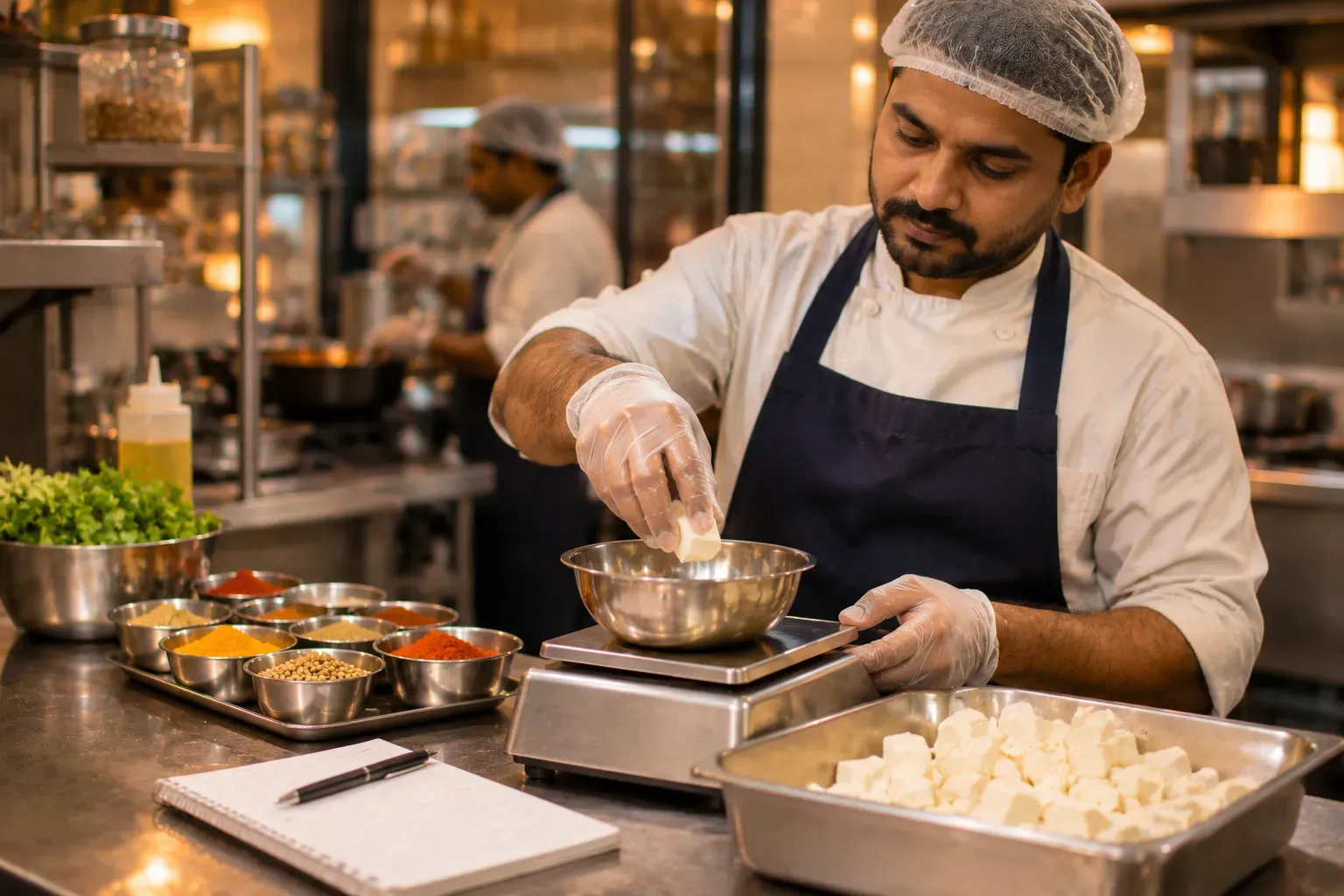
From recipe card to plate cost
What food-cost percentage actually means
Food-cost percentage is simply the cost of the ingredients on the plate divided by the price you sell it for:
Food cost % = (plate cost ÷ selling price) × 100
If a plate costs you ₹100 in ingredients and sells for ₹300, your food cost is 33%. The remaining 67% is not profit. It has to cover rent, salaries, gas, electricity and everything else. But the food-cost number tells you whether a dish is even in the game. The reason most owners guess it is that computing it honestly requires four things people skip: exact recipe quantities, yield losses, unit conversion and batch maths. Here is how to do each, in order.
Step 1: Write the recipe card — including the invisible ingredients
For each dish, write down every ingredient that goes on the plate, with an exact quantity per portion. Not "some butter" — 25 grams of butter. The dishes that lose money quietly are the ones where the invisible ingredients were never counted:
- Oil used in the marinade and in tempering
- Butter finished on top, ghee brushed on at the end
- Curd, ginger-garlic paste and salt in the marinade
- Garnish — coriander, cream swirl, onion rings, the lemon wedge
Individually these look like ₹1–3 items. Across a plate they routinely add ₹8–12, and across three hundred plates a day they are a salary. Stand in the kitchen with a weighing scale while the dish is made once — it is the only reliable way to get real numbers instead of the chef's estimate.
Step 2: Apply yield — cost what you can use, not what you buy
A kilo of raw chicken is not a kilo of usable meat. After trimming fat, sinew and drip loss, boneless chicken typically yields 85–90% usable weight. Peeled onions lose skin and roots; cleaned coriander loses stems. So the true cost of the usable ingredient is:
Usable cost per kg = purchase price ÷ yield
Chicken bought at ₹280 per kg with an 88% yield really costs you ₹280 ÷ 0.88 = ₹318 per usable kg. If your recipe card says 200 g of chicken, cost it at ₹318 per kg, not ₹280. Skipping this step understates the cost of every protein-heavy dish on your menu — usually by 10–15% on the main ingredient alone.
Step 3: Convert purchase units to recipe units
You buy in tins, litres and sacks; your recipes use millilitres and grams. Convert once and write the rate on the recipe card. A 15 kg tin of refined oil at ₹1,950 holds roughly 16,300 ml, so oil costs about ₹0.12 per ml. Fifteen millilitres in a marinade is therefore ₹1.80 — a number you can only get by doing the conversion. Do the same for cream (₹ per ml), spices (₹ per gram) and paneer (₹ per gram). It feels tedious the first time; after that the rates just sit on the card.
Step 4: Cost batch items, then divide per portion
Nobody makes makhani gravy or fried onion masala one plate at a time. For anything made in bulk, cost the entire batch. Add every ingredient, and use the yield after cooking. Divide by the batch weight to get a ₹-per-kg rate for the prepared item. Say a 10 kg batch of base gravy costs ₹950 in ingredients. Your gravy then costs ₹95 per kg. A portion that uses 120 g of it carries ₹11.40 of gravy cost. Treat the batch like a recipe of its own; the per-portion number falls out of it.
Step 5: Add packaging for delivery items
For anything sold for delivery or takeaway, add the packaging to the plate cost. That means the container, lid, cutlery, tissue and carry bag. A decent leak-proof container with a share of a bag is typically ₹10–15. A dish can be comfortably profitable at the table and marginal in a delivery bag; cost the two versions separately so you price them separately.
Step 6: Add it up and compute the percentage
Sum every line on the recipe card to get plate cost, divide by the menu price, multiply by 100. That is your food-cost percentage — per dish, not just for the restaurant overall. The per-dish number is what menu decisions are made from.
Worked example: costing a butter chicken plate
Here is a full costing for a butter chicken (dine-in, one portion) at realistic wholesale rates. Your rates will differ by city and vendor — the method is what matters.
| Ingredient | Qty per plate | Rate | Cost |
|---|---|---|---|
| Chicken, boneless (usable, after 88% yield on ₹280/kg) | 200 g | ₹318/kg | ₹63.60 |
| Butter (cooking + finish) | 25 g | ₹520/kg | ₹13.00 |
| Fresh cream | 50 ml | ₹230/litre | ₹11.50 |
| Cashew paste | 12 g | ₹720/kg | ₹8.64 |
| Tomatoes (for purée) | 200 g | ₹35/kg | ₹7.00 |
| Batch masala mix (spices, kasuri methi, salt) | 12 g | ₹450/kg | ₹5.40 |
| Ginger-garlic paste | 15 g | ₹180/kg | ₹2.70 |
| Curd (marinade) | 30 g | ₹70/kg | ₹2.10 |
| Oil (marinade + tempering) | 15 ml | ₹0.12/ml | ₹1.80 |
| Garnish (coriander, cream swirl, lemon) | — | — | ₹3.00 |
| Plate cost | ₹118.74 |
Against a menu price of ₹349, that is ₹118.74 ÷ ₹349 × 100 = 34.0% food cost. Notice that the invisible lines — masala, ginger-garlic, curd, oil, garnish — add up to ₹15 on this plate. Leave them off the card and you would believe your food cost is 29.7% when it is actually 34%.
The 28–35% guideline, used correctly. A commonly used industry range for food cost is 28–35% — but it is a guideline, not a law. A fine-dining restaurant with high menu prices can run rich plates at 35%+ and still earn well per cover. A quick-service counter with small bills may need to stay under 30%. What matters is knowing your number per dish, and knowing why a dish sits where it does.
Pricing backwards from a target percentage
Costing also works in reverse. If you know a new dish will cost ₹95 to plate and you want to hold roughly 32% food cost, the menu price should be:
Price = plate cost ÷ target % = ₹95 ÷ 0.32 = ₹297 → price at ₹299 or ₹309
Then sanity-check the result against what your guests will actually pay. If the market will not bear the price, you have three honest choices. Reduce the portion. Change the recipe, for example a cheaper cut, less cream or a smarter batch gravy. Or accept a higher percentage on that dish and let lower-cost dishes balance the menu. What you should not do is shrink the recipe in the kitchen while the recipe card still shows the old quantities — then your costing is fiction again.
The part everyone skips: costs drift
A recipe costing done once is a photograph, not a dashboard. Chicken, cream, tomatoes and oil all move — sometimes 20% in a season. A dish costed at 32% in January can quietly become a 38% dish by June while its menu price stays frozen. Two habits keep the numbers honest:
- Re-cost when purchase prices move. Whenever a major ingredient's rate changes, update the rate once and let it flow through every recipe that uses it. Review your highest-selling dishes monthly at minimum.
- Track wastage separately from recipe cost. Spoilage, over-prep, wrong orders and returned plates are real money, but they are not part of the recipe. Mixing them into plate cost hides both problems: you can no longer see whether pricing is wrong or the kitchen is leaking. Keep a simple daily wastage log with reasons, and fix wastage as its own project.
Do this for your top twenty dishes first. They are the ones that make up most of your sales. You will then know more about your menu economics than most restaurants ever do. The scale, the recipe card and one honest afternoon: that is the whole method.
Recipe costing that stays current on its own
In Zentaro Serve you map a dish to its recipe once. From then on, every sale takes its ingredients out of stock. Plate cost and margin follow your buying prices, and wastage is tracked. You can compare vendor prices before you buy. The menu engineering reports show which dishes really earn.
Talk to us