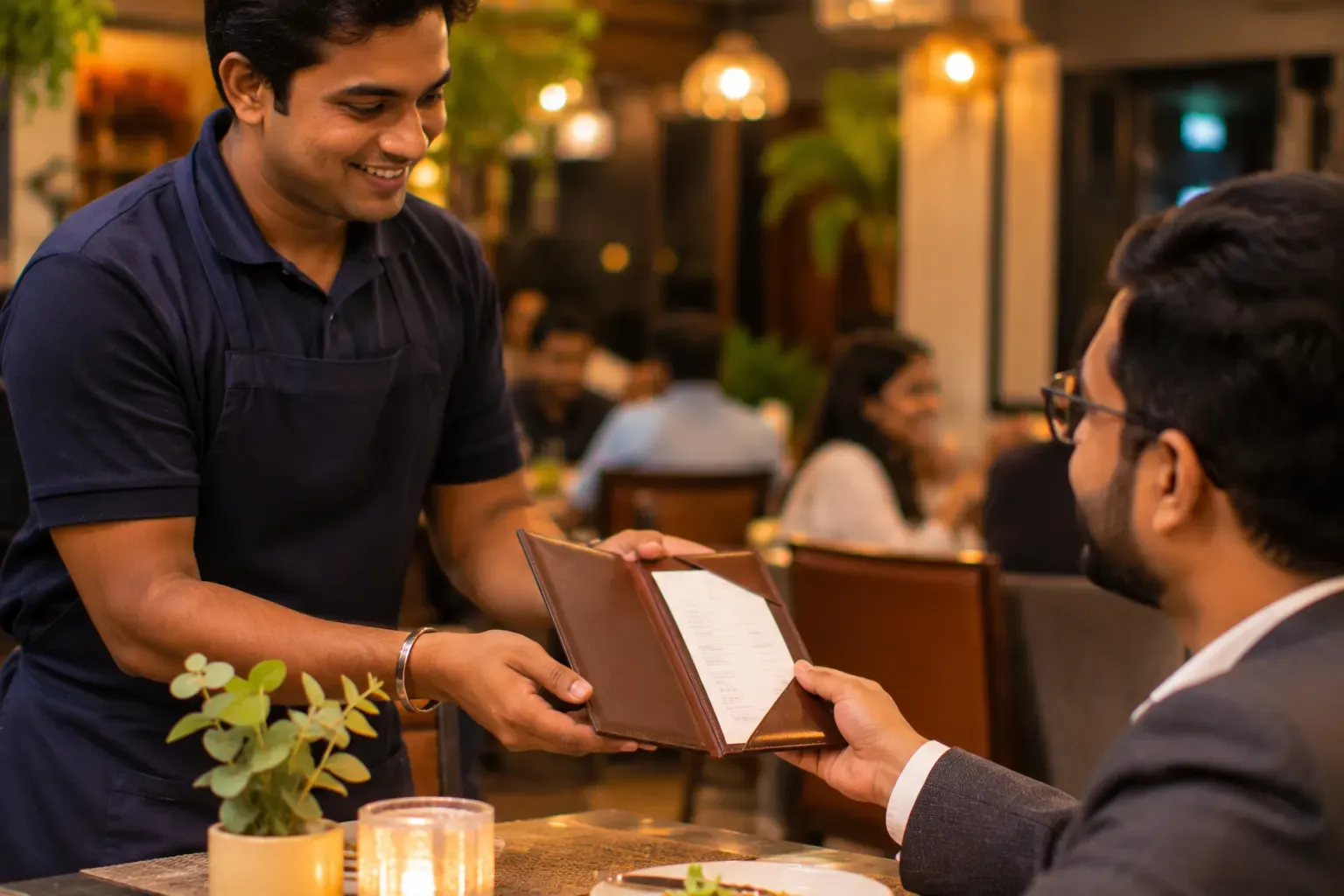
What a compliant invoice carries
One note before we start: this article is educational, not tax advice. GST has situational corners, and the right person to settle your specific case is your chartered accountant.
Which GST rate applies to your restaurant?
For the vast majority of restaurants in India, the common answer, valid as of 18 November 2026, is 5% GST without input tax credit (ITC). Rates and conditions can change, so check the current rule on the GST portal or with your CA. That covers standalone restaurants: dine-in, takeaway, and delivery you bill directly. It applies whether or not the restaurant is air-conditioned or serves alcohol. The alcohol itself sits outside GST and is taxed by the state separately.
The main exception is location. A restaurant operating inside "specified premises" — broadly, a hotel where the room tariff exceeds ₹7,500 per night (valid as of 18 November 2026; check the current limit) — charges 18% GST and can claim input tax credit. If your restaurant sits inside a hotel, this is the first thing to confirm with your CA, because it changes both your billing and your purchase accounting.
| Situation | GST rate | Input tax credit |
|---|---|---|
| Standalone restaurant (dine-in, takeaway, own delivery) | 5% (2.5% CGST + 2.5% SGST) | Not available |
| Restaurant inside specified premises (hotel room tariff above ₹7,500/night) | 18% | Available |
| Composition scheme (small turnover, on opting in) | 5% paid by the restaurant; no tax charged on the bill | Not available |
There is also a composition scheme for restaurants with smaller turnover. As described here, valid as of 18 November 2026, it is a simple 5% arrangement. You pay the tax out of your own pocket, and you cannot show GST on the customer's bill. The rate and the conditions can change, so check the current rule. It changes your invoicing format and your obligations, so treat it as a deliberate decision made with your CA — not a default.
The 5% rate has a catch worth pricing in. "Without input tax credit" means the GST you pay on rent, raw materials, equipment and services is a cost to you. You cannot set it off against the GST you collect. Build that into your menu pricing rather than discovering it in your margins.
CGST + SGST, or IGST?
GST splits into components depending on where the supply happens. When supplier and customer are in the same state, the tax divides equally between the Centre and the state: CGST + SGST. When the supply crosses state lines, it becomes a single IGST at the full rate.
For a restaurant, the place of supply of the service is where the food is actually served — your premises. The customer eats where you are, so the supply is almost always within your state. Your bills should almost always show the rate split into two equal halves. At the standard rate that is 2.5% CGST plus 2.5% SGST. If you ever see a restaurant bill showing IGST for a regular dine-in order, something is misconfigured.
The split is not cosmetic. Each component is accounted for separately, and each must be calculated and rounded correctly on its own — more on that below.
What a compliant tax invoice must contain
Rule 46 of the CGST Rules lists what a tax invoice must carry. For a restaurant, the practical checklist is:
- Your details: the legal name, address and GSTIN of your restaurant (the supplier).
- A consecutive serial number: Rule 46(b) requires a serial number of up to 16 characters, unique for the financial year, running consecutively. You can use letters, numbers, and separators like a hyphen or slash — but the series must not have gaps or repeats.
- Date of issue.
- HSN/SAC code: restaurant service falls under SAC 9963. Goods you sell alongside (packaged water, retail items) carry their own HSN codes.
- Description and value of what was supplied, including the taxable value.
- Tax rate and tax amount, split by component: CGST and SGST shown separately (or IGST, in the rare inter-state case), each with its own rate and amount.
- Recipient's GSTIN for B2B bills: when a registered business asks for a GST bill — a corporate booking, a catering order — their name, address and GSTIN go on the invoice. Without it, they cannot account for the purchase properly.
The serial number rule deserves emphasis because it is the one most often broken by manual billing. A bill book that skips numbers creates gaps. So does a duplicate number after a reprint, or a series that quietly restarts mid-year. Each one makes a mismatch between what you issued and what you report, and that is the kind of gap that draws scrutiny.
Service charge is not a tax
Many bills show "service charge" near the tax lines, and many customers — and some owners — assume it is a government levy. It is not. Under the CCPA guidelines it cannot be added by default. The consumer authority (CCPA) issued guidelines on 4 July 2022. The Delhi High Court upheld them on 28 March 2025. A service charge must be voluntary. It cannot be added to the bill by default or under another name (official guidelines, PDF). Two things follow from that:
- It must never be presented as a tax or bundled into the tax lines.
- If a guest chooses to add a tip or service amount, keep it on its own line. How GST applies to it is a tax question, so ask your CA and check the current rules.
Getting this wrong makes your records unclear on every single bill, and a default charge can also break consumer rules.
Common mistakes to avoid
- Gaps or duplicates in the invoice series. Every skipped or repeated number is a discrepancy you may have to explain later.
- Rounding tax per bill instead of per component. CGST and SGST are separate taxes; each should be computed and rounded on its own. Rounding one combined figure and splitting it in half produces paisa-level mismatches that add up across thousands of bills.
- Charging 18% by habit. Some restaurants carried old service-tax-era instincts into GST. Unless you are inside specified premises, 18% is simply the wrong rate — and collecting excess tax creates its own problem.
- Adding a service charge by default, as covered above. Keep any tip line optional.
- Treating the composition scheme casually. Opting in while still printing tax on bills, or crossing the turnover limit without noticing, are both costly. If composition is on your mind, sit with your CA first.
Where your CA comes in
Everything above is about issuing correct invoices — the part that happens inside your restaurant every day. Return filing, reconciliation, notices and scheme elections are a different discipline, and we deliberately won't walk through them here: that work belongs with a chartered accountant who knows your books. Your job is to hand your CA clean, complete, correctly numbered billing data. Do that, and the filing side becomes routine instead of a monthly fire drill.
This article is for general education and is not tax or legal advice. Rates and rules described are as commonly applied to restaurants; confirm your specific situation with your CA.
Billing that gets GST right on every bill
Zentaro Serve applies CGST and SGST, or IGST, based on the place of supply. It numbers every invoice in the Rule 46(b) format, unique for each terminal. It carries HSN codes on your items. It produces GST reports you can hand to your CA. It doesn't file your returns — your CA does that, with clean data instead of a shoebox of bills.
Talk to us