
Start from the plate
A party quote is a per-plate quote times the number of guests. The per-plate figure is where most mistakes happen. Count every cost of one plate, not only the food.
Example: a 100-guest party
This is an example, with made-up numbers and tax left out.
| Cost per plate | Amount |
|---|---|
| Food ingredients | 180 |
| Cooking staff | 35 |
| Fuel | 15 |
| Disposables and packing | 10 |
| Transport | 12 |
| Crockery and equipment hire | 8 |
| Cost of one plate | 260 |
You want a margin of 25 percent of the selling price. So the price is the cost divided by 0.75.
Price per plate = 260 divided by 0.75, about 347. Round to 350.
| Quote | Amount |
|---|---|
| Guests | 100 |
| Per plate | 350 |
| Total | 35,000 |
| Margin | 90 per plate, or 9,000 in all |
A common mistake is to add 25 percent on top of cost: 260 times 1.25 is 325. That gives a margin of only 65 on the plate, or 20 percent of the price. Margin on price and mark-up on cost are different. Pick one method and use it every time.
The advance
An advance protects both sides. Use stages, and write them in the quote.
| Stage | When | Share | Amount on 35,000 |
|---|---|---|---|
| Booking advance | At booking | 30 percent | 10,500 |
| Second payment | 7 days before | 40 percent | 14,000 |
| Balance | On the party day | 30 percent | 10,500 |
Write the rule for cancellation in the quote. For example: advance is refundable up to 14 days before, then part refundable, then not refundable. Your rule can differ. Put it in writing so there is no argument later.
Lock the count
The guest count changes. Agree when it is final.
- Ask for a count at booking.
- Lock the final count 7 days before, with a minimum.
- Allow an increase after the lock, with a note that the price per plate stays the same and extra plates are charged.
- Agree what happens if fewer guests come. Most caterers charge for the locked count.
In the example, if the final count is 110, the total becomes 38,500. The extra 3,500 is added to the balance. Cook for the locked count, plus a small buffer if you offered one.
Menu count
A menu with many dishes costs more to prepare. Cap the number of items per plate. Count the dishes for each course. Do not agree to add dishes at the last minute without changing the price.
Party date and reminders
Write down the date, the time and the place. Then set reminders for yourself and the guest.
- 14 days before: confirm menu and count.
- 7 days before: lock the count and take the second payment.
- 2 days before: confirm the time, the address and the contact on the day.
- The day before: final shopping, prep list, staff list.
A reminder that goes out by itself is better than one that depends on memory.
Keep it in one place
For each party, one record should show:
- The guest, the date and the venue.
- The menu and the count.
- The quote and the stages of payment.
- What was paid, and what is due.
- The staff and equipment booked.
Spreadsheets work at a small scale. When you run several parties a week, a system that links the quote, the advance and the reminders saves errors.
Common questions
How do I quote a party?
Work out the cost of one plate, add your margin, then multiply by the guest count.
How much advance should I take?
It is your choice. A common pattern is a part at booking, a part a week before and the balance on the day.
When should the guest count be final?
Agree a lock date, such as 7 days before, and a rule for increases and decreases.
What is the difference between margin and mark-up?
Margin is a share of the selling price. Mark-up is added on top of cost. They give different prices.
Why send reminders?
They keep the menu, count and payments on track and stop last-minute surprises.
Where Zentaro Serve fits
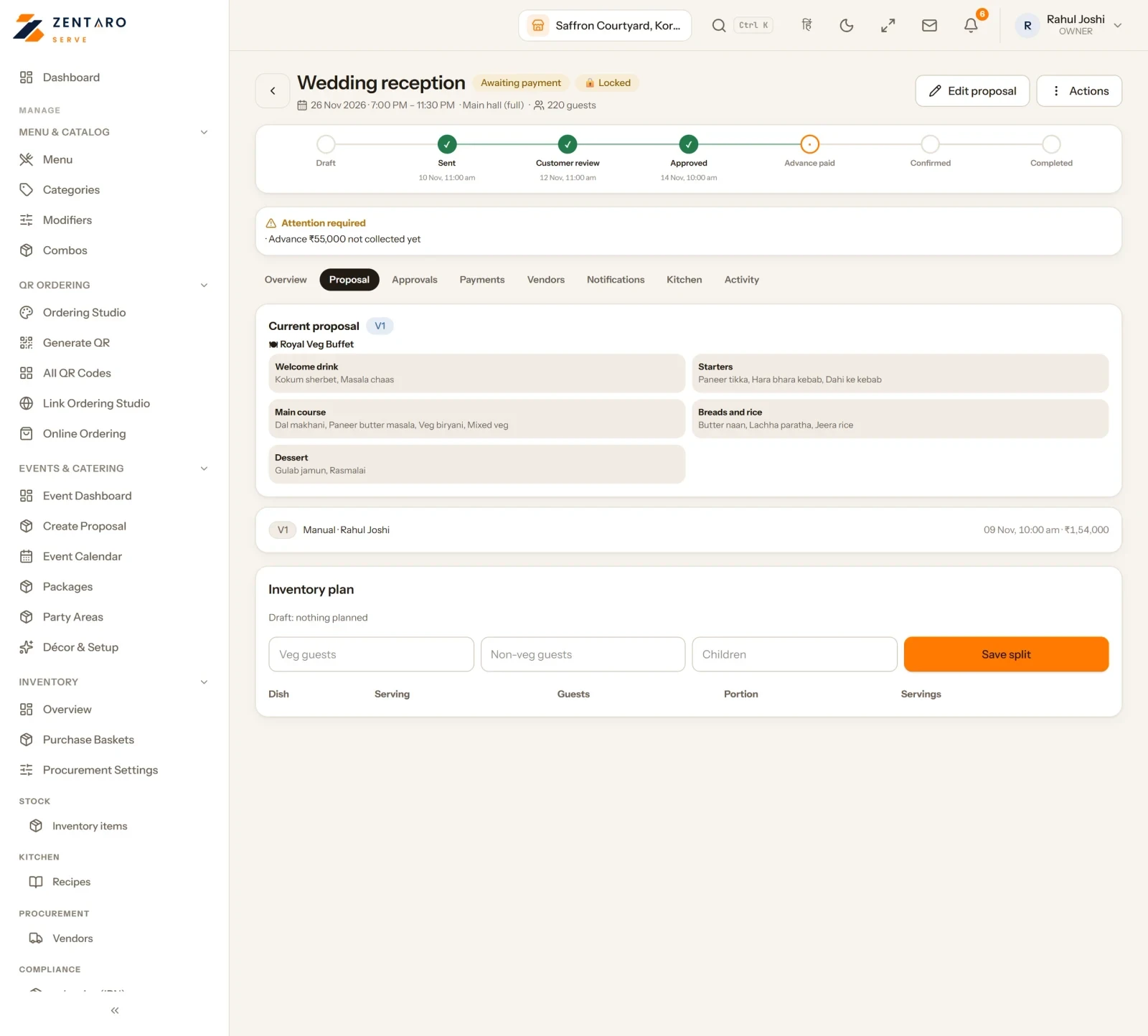
Zentaro Serve runs party and banquet bookings with proposals and advances, and takes table reservations.
See event and booking software