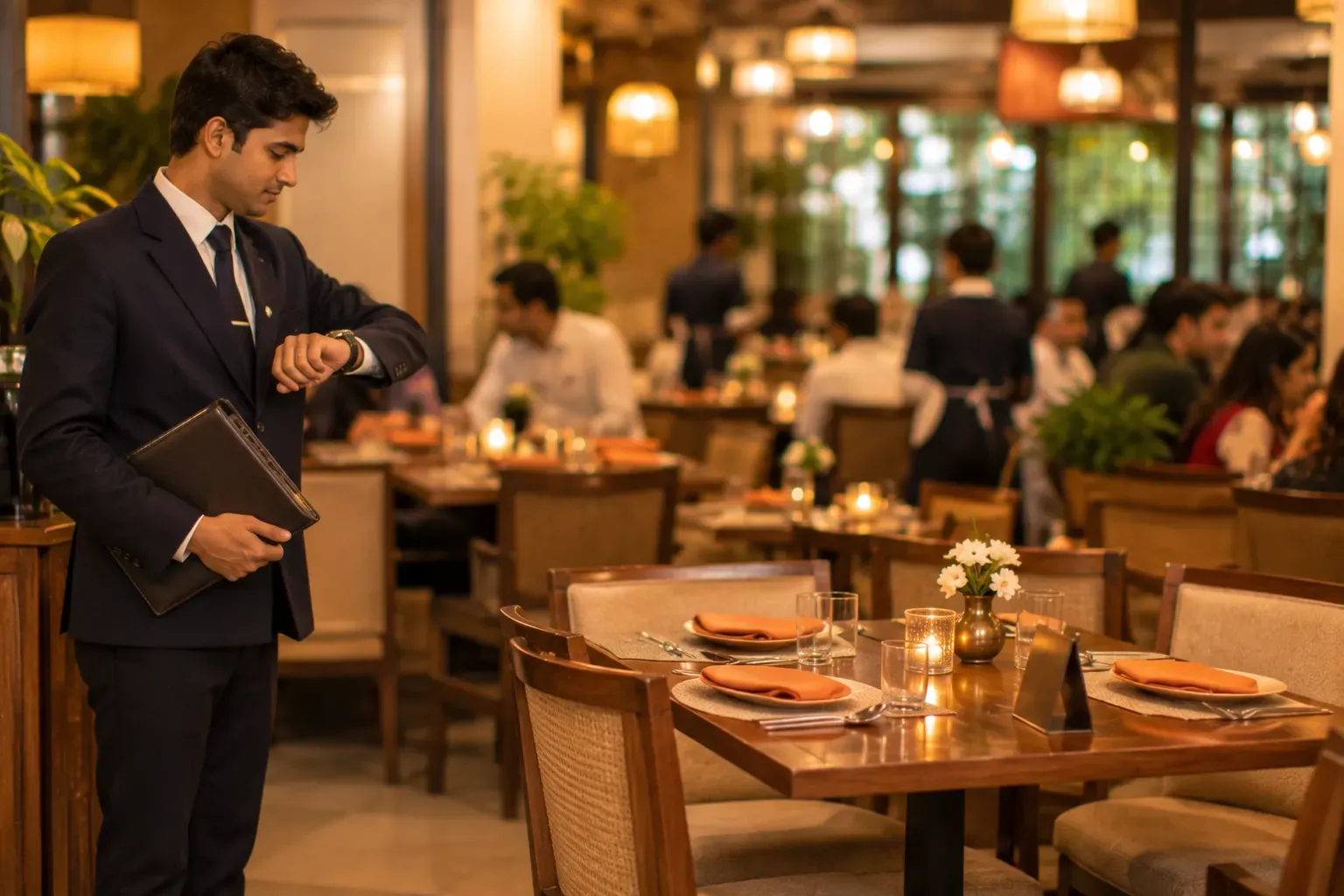
An advance-backed reservation
The uncomfortable truth is that a free reservation is a promise that costs the guest nothing to break. In every other business that holds capacity — hotels, airlines, salons — a hold has a price. Restaurants held out because collecting a small advance used to be awkward: card machine over the phone, "transfer to this number", a screenshot as a receipt.
What changes when the advance is a link
Payment links removed the awkwardness. The modern version of a reservation with an advance looks like this:
The booking is taken with an amount attached. Party size, table, time — and the advance the booking is worth. For a regular Tuesday four-top that may be zero; for the Saturday eight-top or the private dining room, it isn't.
The guest pays from their phone (in progress). A payment link goes out; UPI or card; done in three taps. No reading card numbers over the phone, no bank-transfer archaeology. Today you can take an advance with a table booking; the automatic payment link is being built.
The system does the reminding (in progress). Until the advance is paid, the follow-up is automatic. Your host desk does not keep a call-back list, and nobody has to be the person who phones a guest about money. Automatic reminders for table advances are being built.
The cut-off does the deciding (in progress). This is the step that pays for everything. You set a time by which the advance must arrive. If it has not arrived by then, the table goes back into service. There is no judgement call at 7:55 and no awkward conversation. If it has arrived, the hold is real, backed by the guest's own money, and your cancellation policy decides what happens to it if they do not come. Either way, you avoid an empty eight-top. Release at a cut-off is in progress; today you release the table by hand.
The advance lands on the bill. When the party arrives, the amount is already sitting against the reservation and settles into the final bill. No arithmetic at the table, no "adjust it in the total, boss".
"Won't guests be offended?"
The fear is understandable and mostly out of date. Guests who book weekend prime-time tables also book flights and salon appointments — they live with holds and advances everywhere else. What genuinely offends guests is a badly handled version: a demand for money with no receipt, or an advance that mysteriously can't be found at billing time. A link with a proper receipt, and an amount that appears on the final bill by itself, reads as professionalism, not distrust.
Start where the losses are: prime-time slots, large parties, private rooms, festival dates. Leave the Tuesday four-top free. The point is not to tax every booking — it is that the bookings capable of hurting you are backed by something real.
One Saturday's worth of honesty: count the covers you refused while holding tables for parties that never came. That number, times your average cover, is what free reservations cost you this week — and it's usually more than enough to justify asking the eight-top for a modest advance.
Hope is not a table-management strategy. An advance, a reminder and a cut-off are.