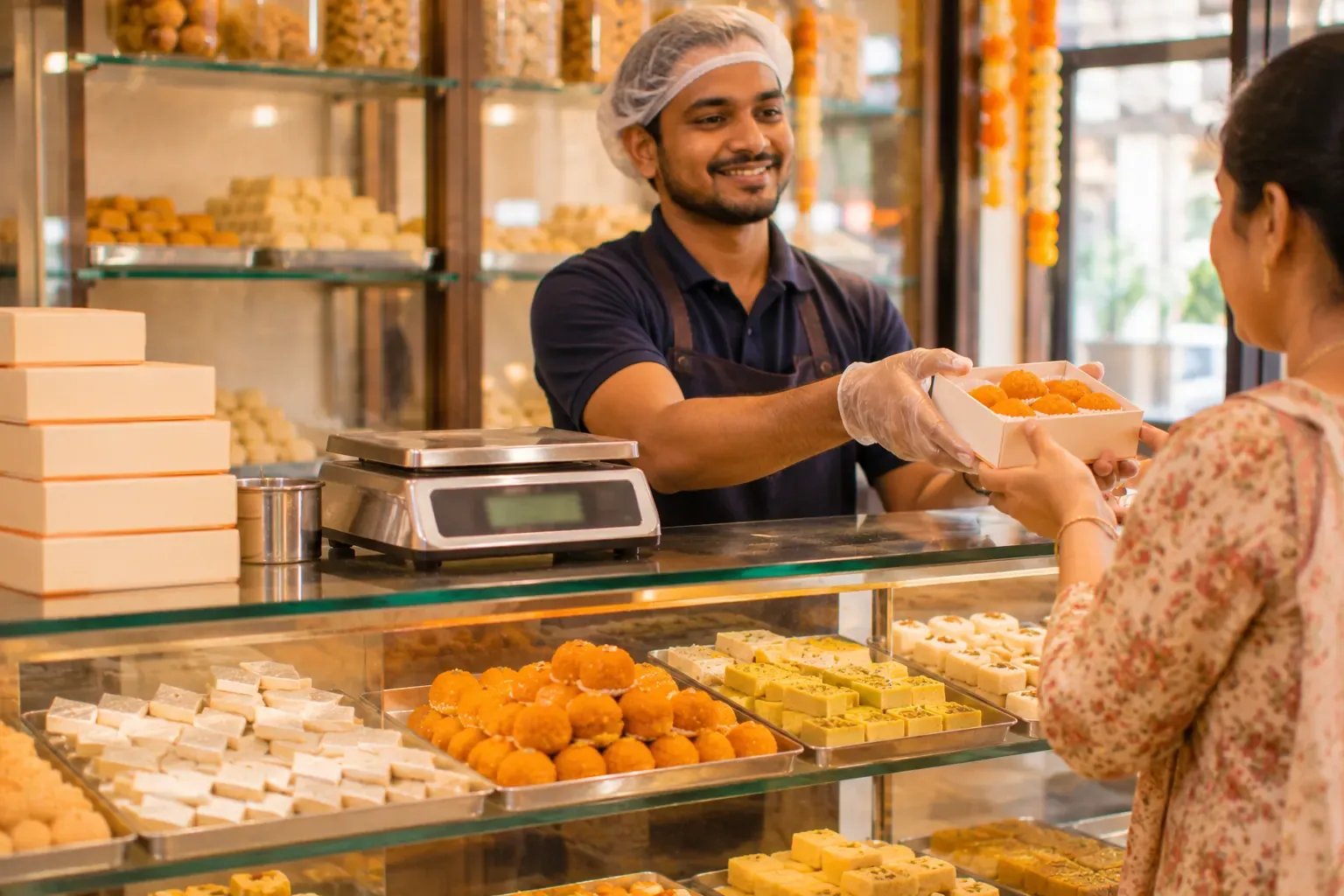
Two kinds of sale
Loose items by weight and boxes are two different kinds of sale.
| Item | Loose by weight | Box |
|---|---|---|
| Example | 500 g of kaju katli | A boxed assortment |
| Price | Per kilo, times the weight | One fixed price |
| Weighing | Needed, with tare | Not needed |
| Risk | Wrong weight, forgotten tare | Contents change but the price does not |
One guest often buys both. The bill must carry both without confusion.
Tare: the small thing that costs money
Tare means taking away the weight of the box or tray, so you charge only for the sweet.
Example: kaju katli is 1,000 per kilo. A guest asks for 500 g in a box. The scale reads 540 g with the box. The box weighs 40 g. After tare, the net weight is 500 g, and the price is 500. If the cashier forgets tare, the guest pays for 540 g, which is 540. The guest is overcharged by 40.
On 100 such bills a day, a forgotten tare of 40 g at this rate would overcharge guests by 4,000 in total. The habit is simple: put the box on the scale, press tare, add the sweet, read the net weight.
Example: a sample bill
This is an example, with made-up prices.
| Line | Quantity | Rate | Amount |
|---|---|---|---|
| Kaju katli, loose | 500 g | 1,000 per kg | 500 |
| Motichoor laddu, loose | 250 g | 600 per kg | 150 |
| Assorted box, medium | 1 box | 250 each | 250 |
| Total before tax | 900 |
The loose lines come from weight times rate: 0.5 kg times 1,000 is 500, and 0.25 kg times 600 is 150. The box is a plain one-piece item. The three lines add up to 900 before tax.
Ask your accountant how tax is shown on loose and packed sweets, since the treatment can depend on how you sell them.
Price a box
A box has more costs than the sweets in it.
| Part of the box | Cost, made-up |
|---|---|
| Sweets inside | 130 |
| Box and ribbon | 25 |
| Labour for filling | 10 |
| Cost of one box | 165 |
At a price of 250, the margin is 85. Do not forget the cost of the box. A guest who asks for a "special box" with a fancier wrapper should pay for it.
Festive price
Festival weeks have special prices and special boxes. Do not change prices by hand every year. Set the festive price to run on a date window: it starts on one date and ends on another, then the normal price returns. See festive-season pricing with date windows.
Raw material stock
Sweets are made from milk, khoya, sugar, ghee, dry fruit and flour. Their prices move. If you do not track them, you do not know what a sweet really costs.
Example batch, made-up: a 10 kg batch of barfi uses 6 kg khoya, 3 kg sugar and 0.5 kg ghee, plus 0.5 kg dry fruit. After cooking and cutting, you get 9.2 kg. The yield is 92 percent. Cost per kilo of finished barfi is the total ingredient cost divided by 9.2, not by 10. See yield and portion size.
Record raw material you buy, and record each batch you make. Then compare stock with sales. Sweets that spoil quickly, like milk sweets, need tight control. Our stock register guide shows the format.
Counter habits that help
- Keep the scale checked and level. Use a scale that is verified and stamped as the law requires. Under the Legal Metrology rules, sell by net weight and show the net weight to the guest. Pre-packed boxes may need a net weight and other declarations on the pack. Ask the Legal Metrology office in your state about your case.
- Put the price per kilo on the tray label.
- Ring every sale. A sale that is not rung is a loss you cannot see.
- Count the boxes in stock each night.
Common questions
How do I bill loose sweets and boxes together?
Use two kinds of line on one bill: weight times rate for loose sweets, and a fixed price for each box.
What is tare?
It means taking away the weight of the box or tray, so the bill counts only the sweet.
How should I price a box?
Add the cost of the sweets, the box and ribbon and the filling labour, then set a price with your margin.
How do I handle festival prices?
Set the festive price on a date window, so it starts and ends by itself.
Why track raw material stock?
Ingredient prices move. Tracking them tells you what each sweet really costs.