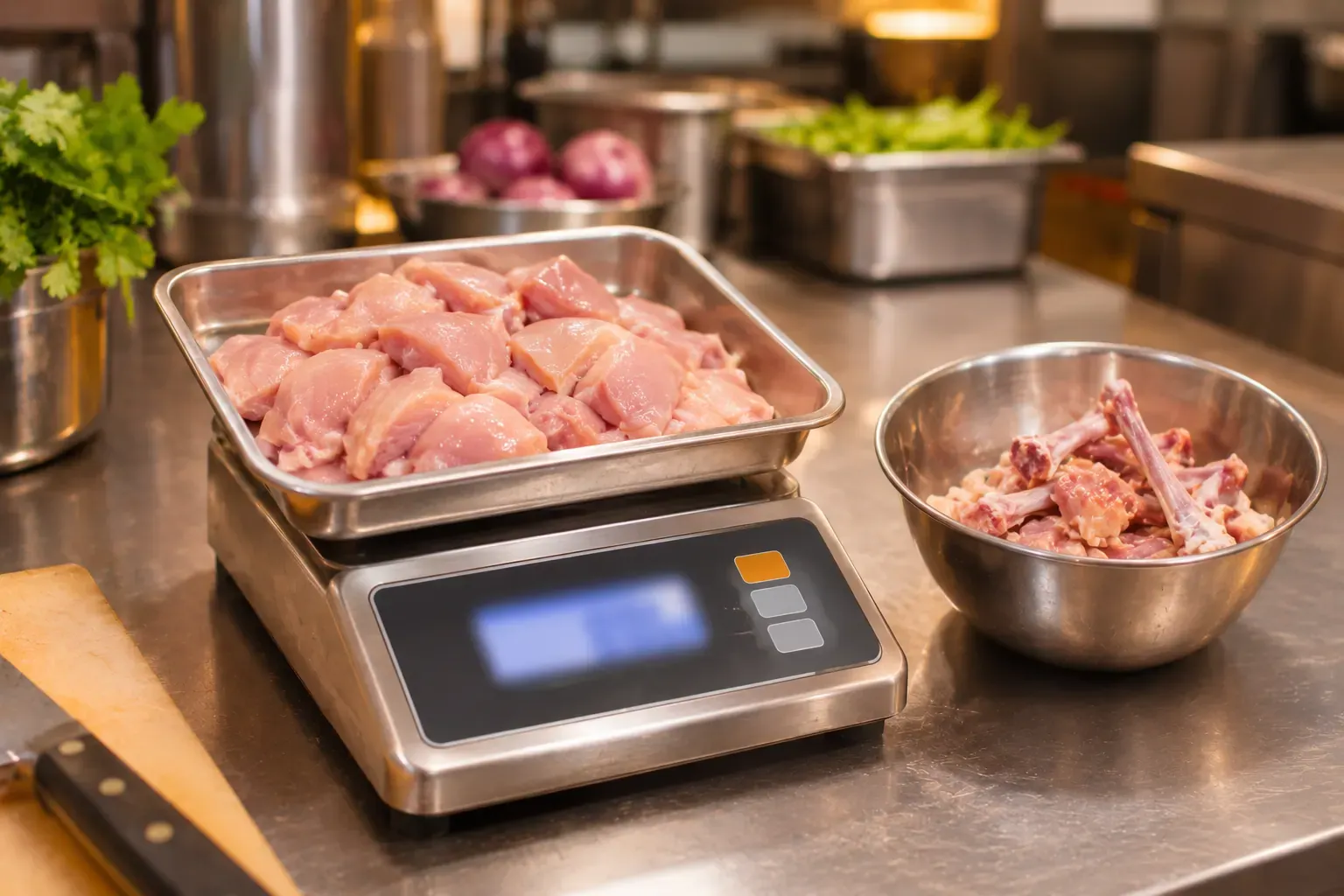
What yield means
Yield is the usable part of an item, after you remove what you will not serve. A whole chicken has bone, skin and fat. A bunch of coriander has stalks. A fish has a head and bones. You pay for the full weight, but you serve only part of it.
Yield is shown as a percentage:
Yield % = usable weight divided by purchased weight, times 100
Why test it
- Your recipe cost is wrong if you cost the full weight, because you serve less.
- Two suppliers can sell the same item with different yields.
- Staff skill changes yield. A careful cook wastes less.
- The yield gives you the true cost per usable kilo.
How to run a yield test
You need a scale, a tray and a few minutes.
- Weigh the item as you buy it. Write the weight.
- Trim and clean it the way you normally do.
- Weigh the usable part. If the dish is cooked, weigh it after cooking too.
- Weigh the trim and waste. The usable weight and the trim should add up to about the purchased weight. A big gap means you made an error.
- Work out the yield percentage.
- Repeat two or three times. Use the average.
Do it with your real cook, not the best cook. Yield in real life is what matters.
Trim loss
Trim loss is the weight you cut away. It is the opposite of yield. If yield is 70 percent, trim loss is 30 percent.
Trim loss is a normal cost. It belongs in your recipe cost, not in the wastage register. Wastage is the extra loss beyond the normal trim.
Set the portion size
Once you know the usable weight, decide how much goes on a plate. This is the portion size.
- Pick a weight, such as 150 g of cooked chicken.
- Use a scale or a measuring cup for the first weeks, so cooks learn it.
- Use a fixed spoon or ladle for gravies and rice. A ladle is a portion tool.
- Write the portion in the standard recipe.
A standard recipe lists each ingredient, its quantity and the portion size. Every cook follows it, so every plate is the same. See how to cost a dish.
Work out portion cost
Portion cost = cost per usable kilo x portion weight in kilos
The cost per usable kilo is higher than the buying price, because of trim loss. This is the unit conversion step: you convert the price per purchased kilo into a price per usable kilo.
Cost per usable kilo = total cost of the purchase divided by usable weight
Example: a 5 kg chicken yield test
This is an example, with made-up numbers. A kitchen buys 5 kg of chicken with bones at 200 per kg. It runs a yield test.
| Step | Result |
|---|---|
| Purchased weight | 5 kg |
| Total cost | 5 x 200 = 1,000 |
| Usable meat after trimming | 3.5 kg |
| Trim and bones | 1.5 kg |
| Yield | 3.5 / 5 = 70 percent |
| Cost per usable kilo | 1,000 / 3.5 = about 286 |
| Portion size | 150 g (0.15 kg) of trimmed raw meat |
| Portions from the batch | 3.5 / 0.15 = about 23 |
| Portion cost | 286 x 0.15 = about 43 |
If the cook had used the buying price of 200, the portion would cost 30. The real cost is about 43. That is a big difference. Over many plates, the mistake costs real money.
Repeat when things change
Run the test again when:
- You change supplier or cut.
- A new cook starts.
- The product looks different, for example smaller birds.
- Your cost is higher than expected.
Our recipe cost calculator works out the plate cost from your yield and portion.
Common mistakes
- Costing the purchased weight. Use the usable weight.
- Testing once. Repeat two or three times and take the average.
- No scale. Guessing yield is a coin flip.
- No standard recipe. Portions drift from cook to cook.
- Forgetting cooking loss. Meat shrinks when cooked. Weigh it again after cooking if the portion is cooked weight.
A short checklist
- Have you weighed the purchase, the usable part and the trim?
- Is the yield written down, as a percentage?
- Is the portion size fixed, in the standard recipe?
- Is the portion cost based on cost per usable kilo?
- Do you repeat the test when something changes?
Common questions
What is a yield test?
A yield test weighs an item before and after trimming to find how much is usable. It gives you a yield percentage.
How do I work out yield percentage?
Divide the usable weight by the purchased weight and multiply by 100.
What is trim loss?
It is the weight you cut away, such as bones and peel. If yield is 70 percent, trim loss is 30 percent.
How do I work out portion cost?
Work out the cost per usable kilo, then multiply it by the portion weight in kilos.
How often should I repeat a yield test?
Repeat it when the supplier, the cut or the cook changes, or when your cost seems too high.
Where Zentaro Serve fits
In Zentaro Serve dishes can have a recipe, and food cost follows your buying prices.
Try the recipe cost calculator