What a stock register does
A register shows where your raw material went. Without it, you only learn about a loss when the shelf is empty or the cash is short.
A good register answers three questions every week:
- How much of each item did we have, buy and use?
- What should be on the shelf now?
- What is really on the shelf, and why does it differ?
You do not need to track every pinch of salt. Start with the items that cost the most and move fastest: rice, oil, paneer, chicken, dairy, flour, gas.
The columns, one by one
| Column | Meaning |
|---|---|
| Item and unit | Name and unit of measure, such as rice in kg or oil in litres |
| Opening | What you had at the start of the period |
| Received | What came in, from supplier bills |
| Used | What went out to the kitchen |
| Expected closing | Opening + received − used |
| Physical count | What you counted on the shelf |
| Variance | Physical count − expected closing |
| Remarks | The reason for any variance |
Keep one unit for each item and never change it. If rice is in kg, write kg every time. A mix of kg and sacks is how counts go wrong.
Where each number comes from
- Opening is last period's closing. Copy it, do not guess it.
- Received comes from supplier bills or a goods received slip. Count the item when it arrives, and match it to the bill.
- Used comes from kitchen issue slips, or from recipe use if your software tracks it. For a small kitchen, the cook writes what was taken from the store.
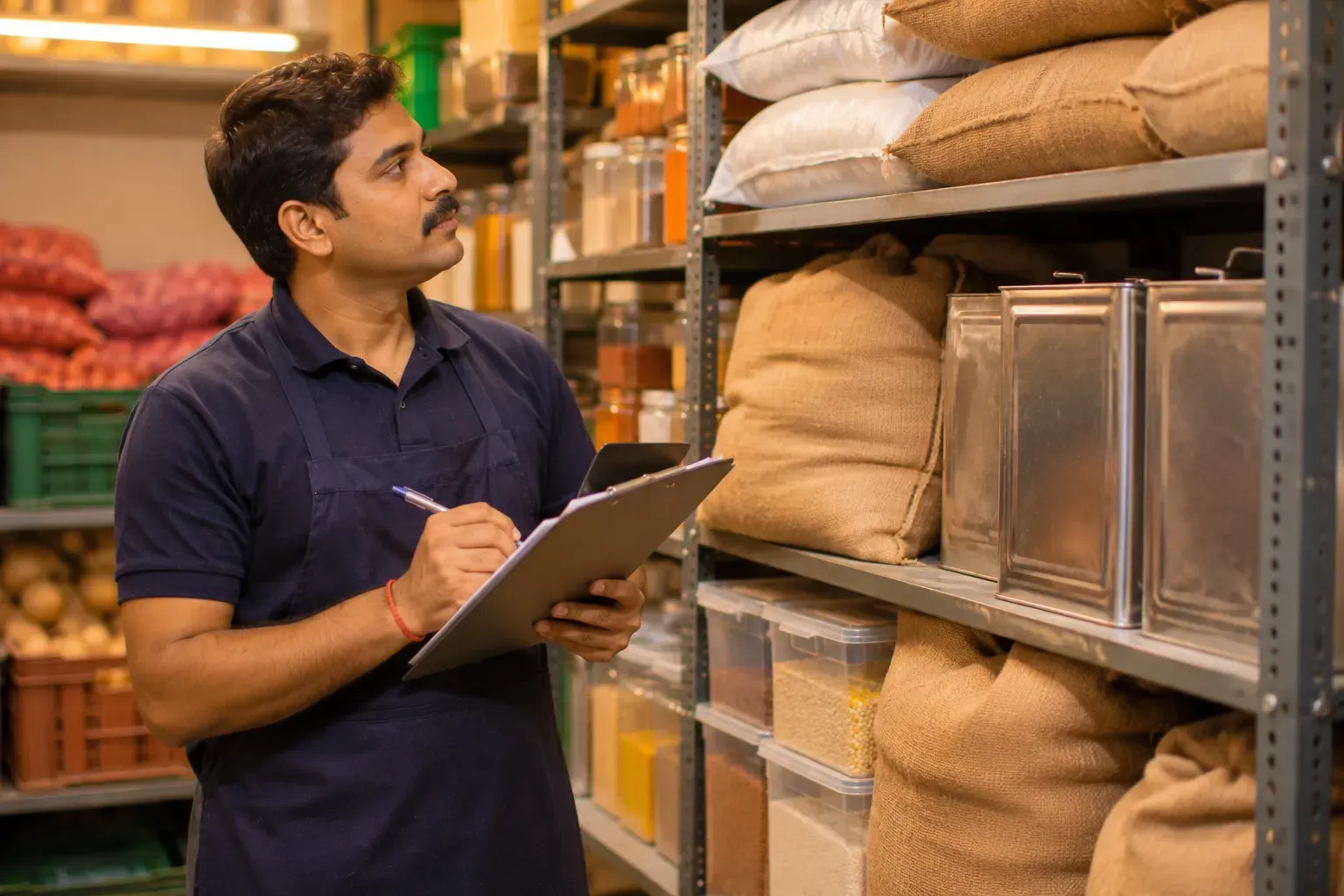
- Physical count comes from a real count, by a person, at a set time. Count after service, when nothing is moving.
How often to count
- Daily for fast items like dairy, vegetables and meat.
- Weekly for most dry goods like rice, flour, oil and pulses.
- Monthly for slow stock and a full check of the store.
A weekly count of your top items is a good start. A printable daily stock count sheet helps.
Example: a rice and oil register for one week
This is an example with made-up numbers.
| Item | Opening | Received | Used | Expected closing | Physical count | Variance |
|---|---|---|---|---|---|---|
| Basmati rice (kg) | 40 | 50 | 62 | 28 | 27 | −1 |
| Refined oil (litres) | 30 | 30 | 47 | 13 | 10 | −3 |
Rice shows a variance of minus 1 kg. That is small and easy to explain: a spilled bag, or an estimate of use. It is not worth a hunt.
Oil shows minus 3 litres. Out of 60 litres that came through, that is a larger share. It is worth a look. Was a can opened and not entered? Was oil taken for staff meals? Was the tin measured at purchase? A short talk with the cook and a check of the store usually finds the reason.
The register did its job. It did not say who did it. It said where to look.
What to do with variance
A variance is a question, not an accusation.
- Check the arithmetic.
- Check the received column against bills.
- Check the used column against issues and sales.
- Ask the cook and the store keeper.
- Write the reason in remarks, even "unknown".
- Watch the item next week. A one-time gap is a mistake. A repeating gap is a leak.
Over time, you learn a normal variance for each item. Oil and flour often run a little off. Paneer or chicken should be tight.
Who keeps the register
Give the register to one named person, and a deputy. Two people should never share the job on the same day, because entries then go missing. The owner or manager should check it once a week, and sign the page.
Keep the store itself tidy. Put one door on it and one key. Keep items in the same place each time, with labels. A tidy store makes counting faster and makes losses easier to see. If a cook needs a lot of an item out of hours, ask for a quick note on the issue slip.
Also separate stock for the kitchen from stock for staff meals, or at least write staff meals as their own use line. Staff meals are a real cost, and hiding them in kitchen use makes the dish costs look wrong.
Common mistakes
- Tracking every item at once and quitting in a week.
- Changing units.
- Copying the expected closing into the physical count column.
- Counting while the kitchen is busy.
- Not matching received stock to the supplier bill.
- Never writing a reason for the variance.
A short checklist
- Does each item have one unit?
- Is opening equal to last closing?
- Is received matched to bills?
- Is the count done by a person, after service?
- Is each variance explained?
- Do you review repeated variances weekly?
Common questions
What columns should a stock register have?
Item and unit, opening, received, used, expected closing, physical count, variance and remarks.
How often should I count stock?
Daily for fast items, weekly for most dry goods, and monthly for a full check.
What is variance in a stock register?
It is the physical count minus the expected closing. It shows loss, error or waste.
Can I keep a stock register in Excel?
Yes. A sheet with these columns works well. Lock the formulas so nobody overwrites them.
Which items should I start with?
The costliest and fastest-moving: rice, oil, paneer, chicken, dairy and gas.
What if the count is higher than the book?
Over is a warning as well. A bill may be missing, or a use was not written down. Check received and used.
Where Zentaro Serve fits
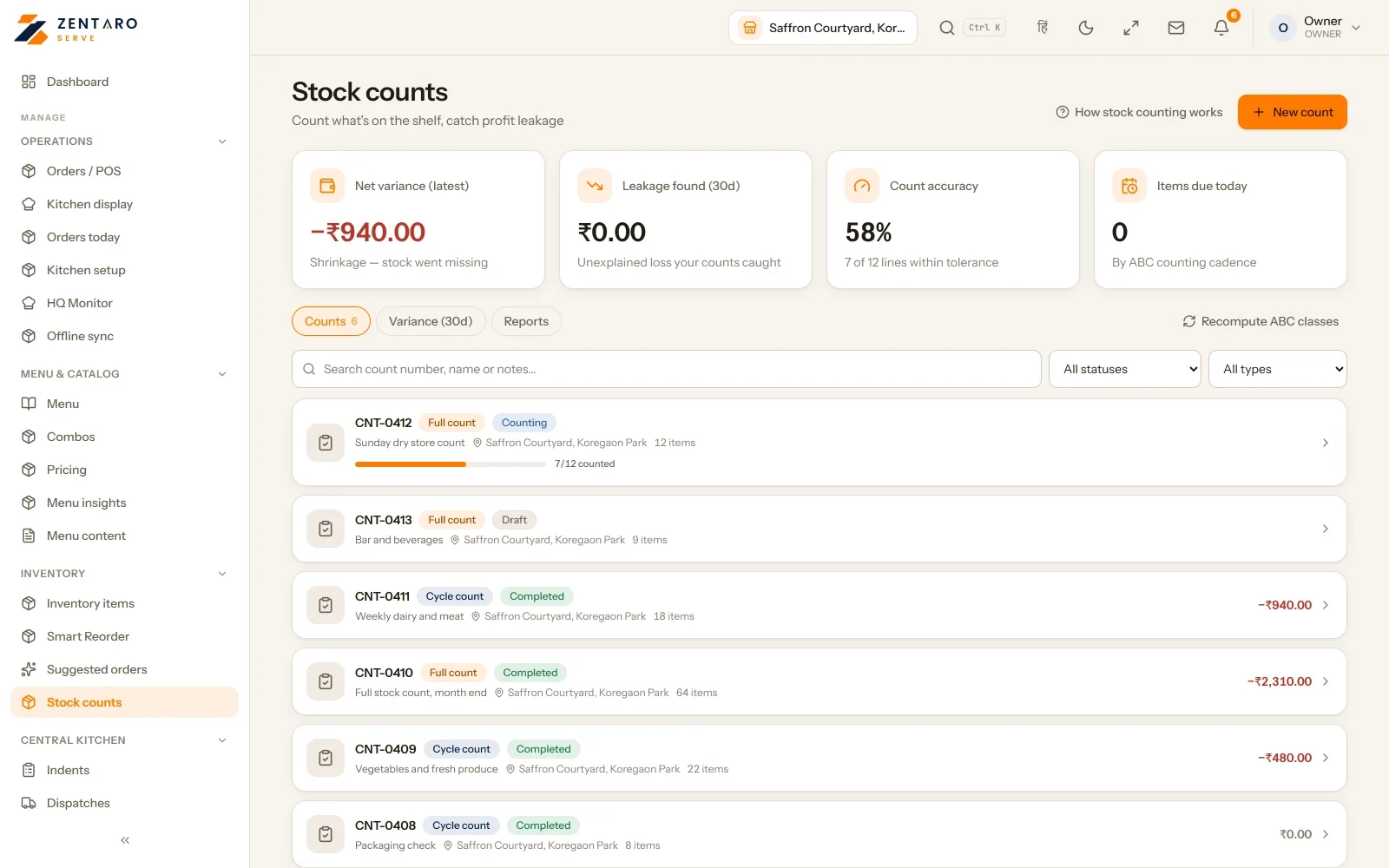
In Zentaro Serve, each dish is linked to its ingredients, so selling a dish takes its ingredients out of stock. Counted stock is then compared with the book figure.
See inventory software