What goes wrong with a bill book
A bill book is cheap and everyone knows it. For a small stall it can be enough. But once you pass a certain number of tables, the book starts to cost you money in quiet ways.
- Arithmetic slips. Adding ten lines by hand in a rush gives wrong totals.
- Missing bills. A torn page or a skipped number is hard to spot.
- No daily total. At night you add up carbon copies, if you have the energy.
- No item view. You cannot tell which dish sold most this month.
- Price changes. When the dal price goes up, someone must remember to tell every waiter.
None of these is a disaster alone. Together they mean you work from guesses.
What a small eatery really needs
Think about the busiest hour, not the average one. Good small restaurant billing must survive that hour.
- Speed. A bill should take a few taps. If it takes longer than writing, the helper will go back to paper.
- Item list and prices in one place. Change a price once, and every bill uses it.
- Cash, UPI and card. Many guests pay by UPI now. The bill should say how each rupee was paid.
- A printed or shared bill. A small thermal printer prints a receipt in seconds. A bill can also go to the guest's phone.
- A daily total. One screen should show sales, by payment type, for the day.
- Works when the network is weak. Highway and village locations drop signal often.
Tax is part of this too. A restaurant that is registered for GST must give a GST bill with the right details. Read our guide to GST on restaurant bills for the basics, and ask your accountant what applies to you.
The small kit that goes with it
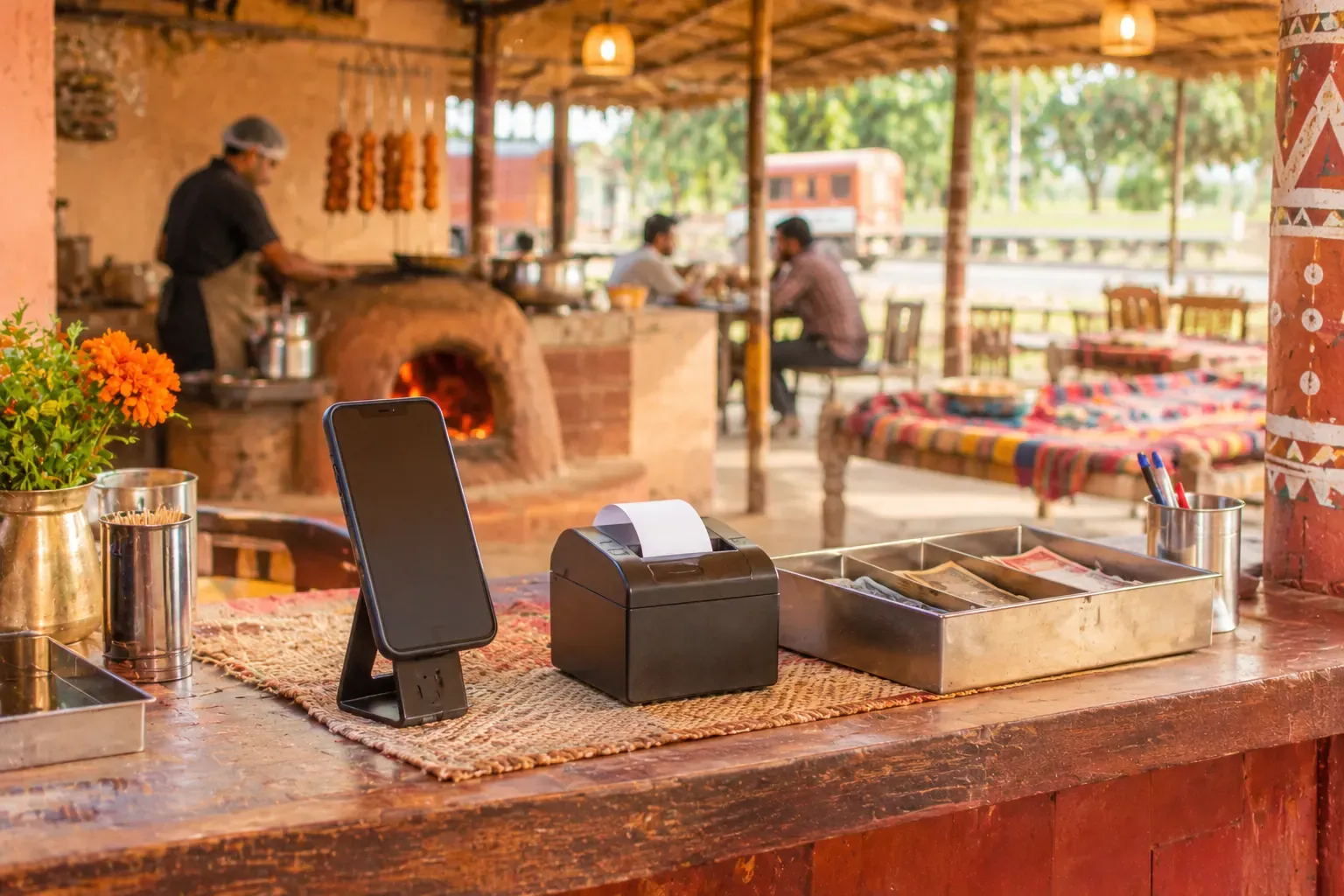
Software alone does not bill. You also need a little hardware.
- A phone, tablet or small computer to take the order.
- A thermal printer for receipts and kitchen slips. It uses paper rolls, not ink.
- A cash drawer that opens when a cash bill is saved. This stops cash going in and out with no record.
- A UPI QR code at the counter, ideally one that matches the bill amount.
Ask any seller which printer models work before you pay for anything.
Example: a highway dhaba on a busy afternoon
This is an example with made-up numbers. A highway dhaba has 12 cots and a counter. Between 1 pm and 3 pm, about 60 bills are made.
Bill book day. The owner's nephew writes each bill with a pen. Three bills have add-up errors, found only when guests complain. Two thali bills are written but not entered in the day's total. At night, the owner adds up the carbon copies for almost an hour. The cash in the box is short by an amount nobody can explain.
Software day. The helper taps the thali and the lassi, picks UPI, and the receipt prints. The total is made by the till. At night the owner opens one screen. It shows sales for the day, split into cash and UPI. He counts the cash drawer and compares it with the cash line. If the two differ, he can open the bills and look.
The dhaba did not become bigger. It simply gained a reliable total and a clear trail.
Common mistakes when a small eatery starts billing on a screen
- Buying a large system with many features that nobody uses.
- Not training the helper. Spend an hour with each person before the first rush.
- Keeping the paper book "just in case" and then using both. Pick one for the day.
- Skipping the daily cash count. The software shows what should be in the drawer. You still have to count it.
- Entering dish names in different spellings. Keep one name for each dish.
A short checklist before you choose
- Can a new helper make a bill in under a minute?
- Does it print on a thermal printer you can buy easily?
- Does it open a cash drawer?
- Does it record UPI, card and cash on the same bill?
- Can you see today's total on your own phone?
- Does it keep billing when the signal drops?
Common questions
What is the best billing machine for a small restaurant?
There is no single best. Pick one that is quick to learn, prints on a common thermal printer and records cash and UPI. Test it in your busiest hour before you commit.
Do I need a GST bill for a dhaba?
That depends on whether you are registered for GST. Ask your accountant. If you are registered, your bill needs the details the rules ask for.
Can I use my phone for billing?
Often yes. Many small eateries bill on a phone or tablet and print to a small thermal printer.
Is a cash drawer really needed?
It is not required. But a drawer that opens only on a saved bill makes it harder for cash to move without a record.
How do I take UPI at the counter?
Show a UPI QR code. The best set-up records the UPI payment on the same bill, so your daily total includes it.
What if my signal is weak?
Ask the seller what happens with no signal. A good system keeps taking bills and catches up later.
Where Zentaro Serve fits
Zentaro Serve takes cash, card and UPI on one bill, prints receipts, opens a cash drawer and keeps billing when the internet drops. Ask us about your printer model first.
See billing software