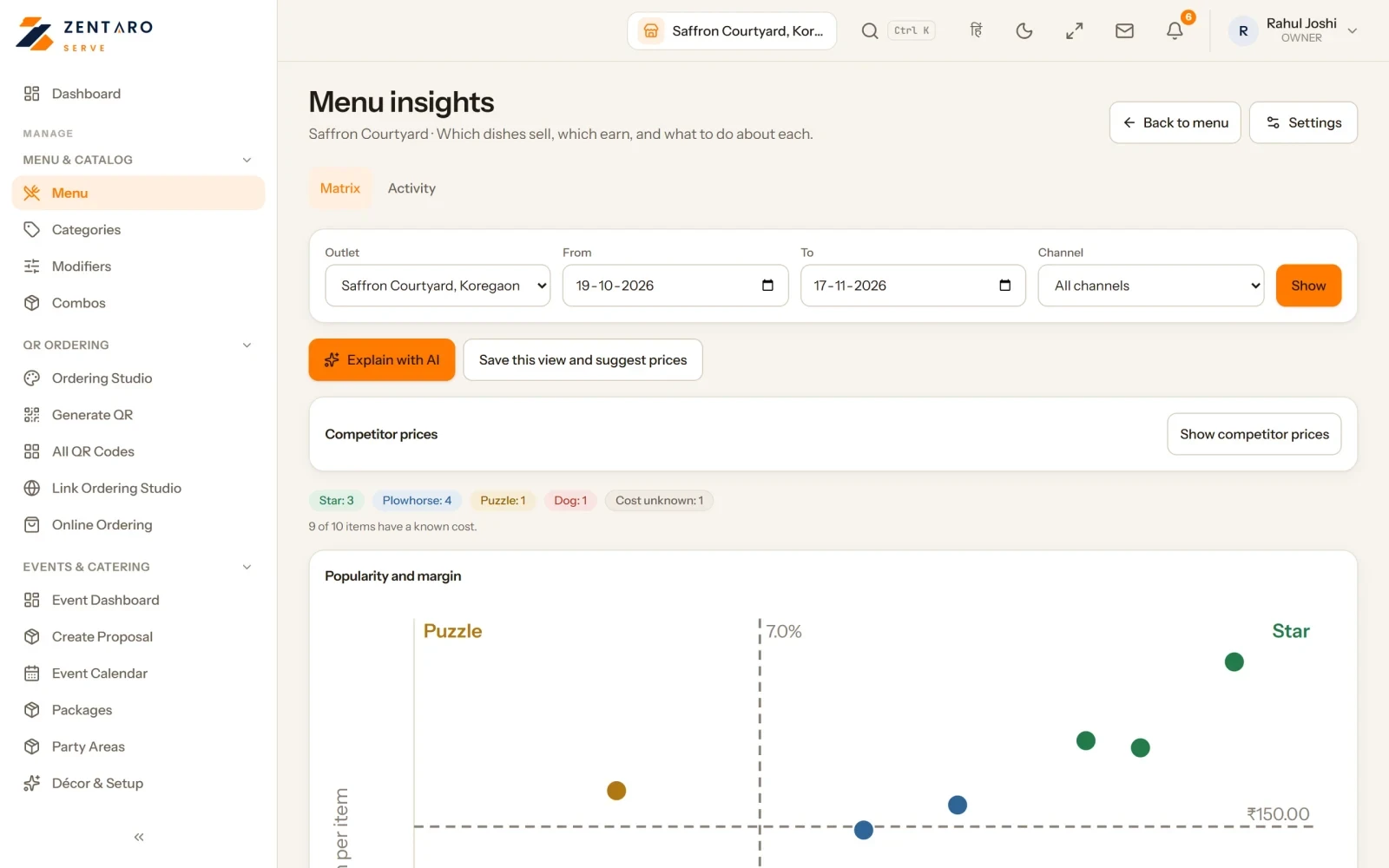
The two numbers
- Popularity. How many of each dish you sold, as a share of all dishes.
- Margin. What each plate earns after its food cost.
Both come from your sales and your plate costs. See how to cost a dish. The sorting is often called stars and dogs. The names people use are stars (popular, high margin), plowhorses (popular, low margin), puzzles (unpopular, high margin) and dogs (unpopular, low margin).
Example: eight dishes
This is an example, with made-up numbers for one month.
| Dish | Sold | Margin per plate | Total margin |
|---|---|---|---|
| Butter chicken | 180 | 150 | 27,000 |
| Paneer tikka | 140 | 130 | 18,200 |
| Dal fry | 160 | 70 | 11,200 |
| Veg biryani | 90 | 120 | 10,800 |
| Fish curry | 30 | 160 | 4,800 |
| Mushroom masala | 25 | 85 | 2,125 |
| Manchow soup | 60 | 55 | 3,300 |
| Lemon rice | 15 | 50 | 750 |
| Total | 700 | 78,175 |
Set the two lines
Popularity line. With eight dishes, an even share would be 12.5 percent each. A common rule counts a dish as popular if it sells at least 70 percent of that, which is 8.75 percent, or about 61 plates of 700.
Margin line. Total margin divided by plates sold: 78,175 divided by 700 is about 112 per plate. A dish above 112 has a high margin.
Sort the dishes
| Dish | Popular? | High margin? | Class |
|---|---|---|---|
| Butter chicken | Yes (180) | Yes (150) | Star |
| Paneer tikka | Yes (140) | Yes (130) | Star |
| Dal fry | Yes (160) | No (70) | Plowhorse |
| Veg biryani | Yes (90) | Yes (120) | Star |
| Fish curry | No (30) | Yes (160) | Puzzle |
| Mushroom masala | No (25) | No (85) | Dog |
| Manchow soup | No (60, just under 61) | No (55) | Dog |
| Lemon rice | No (15) | No (50) | Dog |
The dogs are mushroom masala, manchow soup and lemon rice. They sell 100 plates between them out of 700. They earn 6,175 out of 78,175, about 8 percent of the margin.
The before-you-drop test
A dog is a candidate, not a verdict. Ask three questions for each one.
- Does it pull orders? Some dishes are bought together with a star. Check how often the dish appears on bills with other dishes. If guests who order manchow soup often add a main course, the soup is an opener.
- Does it share ingredients? In this example, lemon rice uses the same rice as the biryani and needs no special prep. Dropping it saves almost nothing. Mushroom masala uses mushrooms that nothing else uses. Dropping it cuts the waste of a short-life item. That helps.
- Does it slow the kitchen? Check prep time. A dish that needs a long prep and sells 25 plates a month is a poor use of a cook's hands.
The decision
| Dish | Test result | Decision |
|---|---|---|
| Mushroom masala | Own ingredient, short shelf life, long prep | Remove |
| Manchow soup | Many guests add a main, uses a stock already made | Keep for now, raise the price a little |
| Lemon rice | No extra cost, shares rice | Keep or merge with another rice dish |
Only one dish goes. The other two get a small fix and a recheck next month.
Do not forget puzzles and plowhorses
Fish curry earns well but sells little. Move it to a better place on the menu, or ask the waiters to suggest it. Dal fry sells well but earns little. Check its cost, and try a small price change. See how to price a dish.
After the change
Remove the dish from every channel, menu and QR menu at once. Tell the staff what to say if a guest asks. Check the sales of the neighbouring dishes next month. If total margin falls, bring it back.
Our menu engineering calculator does the sorting for you.
Common questions
How do I pick a dish to remove?
Sort dishes by popularity and margin. Dishes that sell little and earn little are the first candidates.
What is a dog on a menu?
A dish that is unpopular and has a low margin.
What should I check before I drop a dish?
Whether it pulls orders for other dishes, whether it shares ingredients, and whether it slows the kitchen.
Should I always remove dogs?
No. A dog that opens meals or costs nothing extra may be worth keeping or fixing.
How do I know if removing a dish worked?
Check total margin and the sales of nearby dishes a month later.