What petty cash is
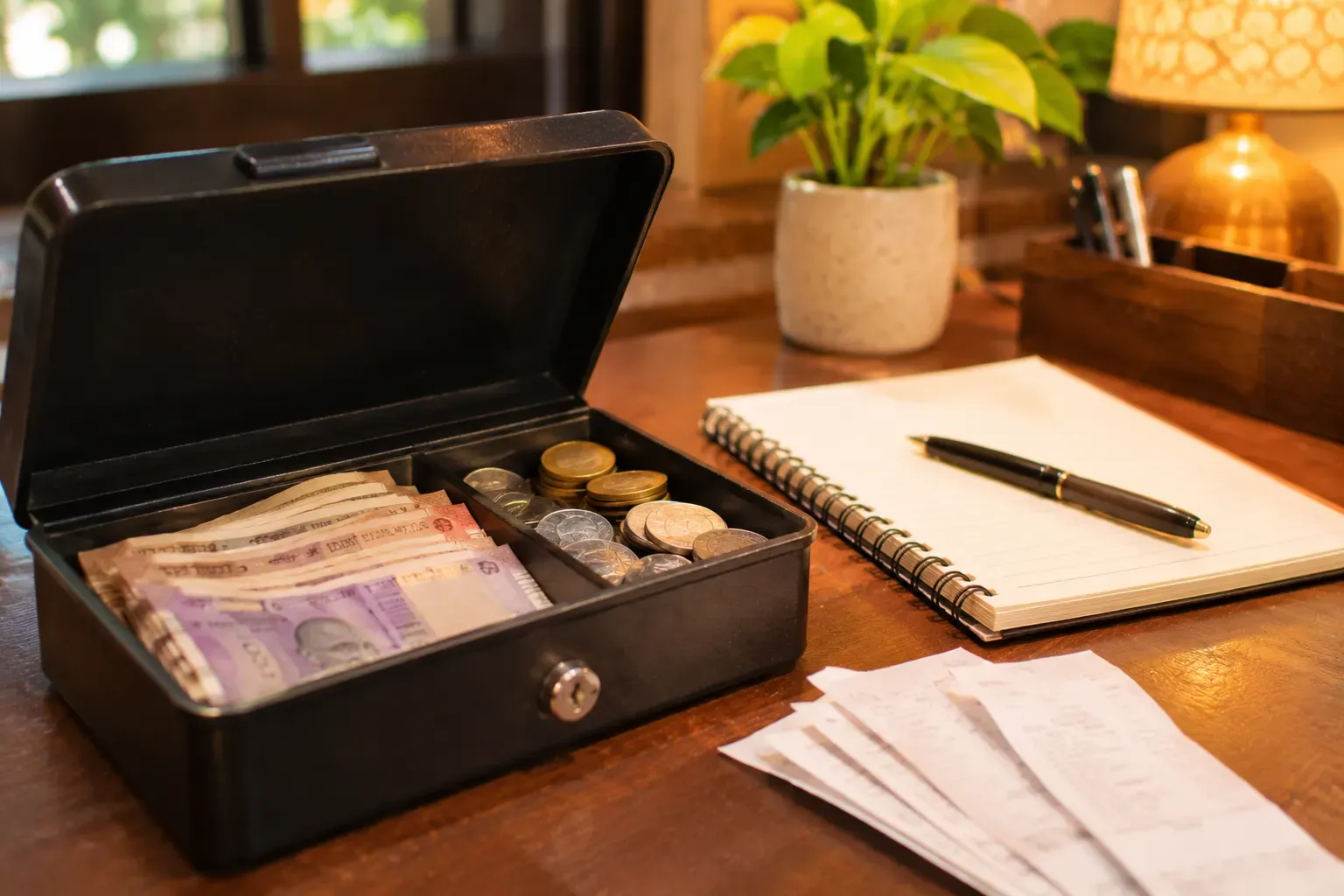
Petty cash is the small amount of cash a restaurant keeps for small buys that cannot wait for a cheque or a supplier bill. A vendor arrives with onions and wants cash. The gas cylinder is delivered and the boy waits. A tip for the delivery man.
These are daily expenses in cash. Each is small. But in a month they add up to a lot, and they are the first place where cash goes missing if nothing is written.
Why it needs its own register
The drawer holds sales cash. Petty cash is taken out of that cash, or from a separate box. If you take ₹300 from the drawer for vegetables and write nothing, the cash looks short by ₹300 at night. The cashier may be blamed. Or worse, the shortage hides real problems.
A register separates the two. Sales cash is sales. Petty cash is a spend with a name and a reason.
A simple register format
You can make this on paper or a sheet. Each line has these columns:
| Column | What goes in it |
|---|---|
| Date | The day of the spend |
| Voucher number | A running number, one per spend |
| Paid to | Person or shop |
| For what | Short reason, such as "milk" or "gas" |
| Category | Groups spends for reports, such as raw material, repairs, cleaning |
| Amount | In rupees |
| Approved by | Who said yes |
| Balance | What is left in the petty cash box |
At the top of the page, write the float. This is the fixed amount you keep in the petty cash box. For example, a restaurant might decide on a float and top it up when it runs low.
The voucher habit
A voucher is a small slip for each spend. It carries the date, amount, reason and the name of the person who took the money. Attach the shop's bill where you can. Give each voucher a number and write the same number in the register.
When a bill is not available, as with a milk seller on a cycle, a voucher written by your team is still better than nothing. Mark it "no bill".
Float and top-up
Use an imprest method. It is simple.
- Decide a fixed float, such as the amount that covers a normal week of small spends.
- Hand it to one named person.
- When it runs low, that person shows the vouchers and the register.
- The manager checks that vouchers plus remaining cash equal the float.
- The manager tops up exactly the amount spent.
At any time, vouchers plus cash in the box should equal the float. If they do not, you know quickly.
Approval
Not everyone can take cash. Set a simple rule.
- Small spends: the shift manager approves.
- Larger spends: the owner approves.
- Nothing is paid without a voucher.
Write the rule on the first page.
Example: a week of petty entries for a 40-seat café
This is an example with made-up amounts.
| Date | Voucher | Paid to | For what | Category | Amount |
|---|---|---|---|---|---|
| Mon | 21 | Milk vendor | Extra milk | Raw material | ₹180 |
| Tue | 22 | Gas agency | Cylinder delivery tip | Utilities | ₹50 |
| Wed | 23 | Local shop | Cleaning cloth and soap | Cleaning | ₹140 |
| Thu | 24 | Plumber | Tap washer fix | Repairs | ₹250 |
| Fri | 25 | Vegetable seller | Coriander, lemon | Raw material | ₹210 |
| Sat | 26 | Courier | Parcel fee | Delivery | ₹60 |
| Sun | 27 | Cleaner | Advance against salary | Staff | ₹500 |
| Total for the week | ₹1,390 |
If the float was ₹2,000, the remaining cash at the end of the week is ₹610. The manager counts ₹610 in the box. Vouchers of ₹1,390 plus ₹610 equal ₹2,000. The register matches.
On Sunday night, the day close subtracts the day's ₹500 from expected cash. The drawer then matches the cash count.
A note on the Sunday line: a salary advance is not a petty spend in the same sense. Many owners keep staff advances in a separate register. Pick what suits you, and be consistent.
Weekly and monthly checks
- Weekly: the manager totals each category, and checks that vouchers and cash equal the float.
- Monthly: the owner looks at the categories. Which spends repeat? Can a supplier deliver instead of you buying from a shop? Is one category growing?
A simple chart of petty cash by category can surprise you. Cleaning and "miscellaneous" often grow quietly.
Common mistakes
- Taking cash from the drawer with no slip.
- One big "miscellaneous" line with no reason.
- No float, so there is no limit.
- Several people dipping into the same box.
- Writing the register at month end, from memory.
- Mixing owner's personal spends into it.
A short checklist
- Is there a fixed float and one named keeper?
- Does every spend have a numbered voucher?
- Is each line approved by the right person?
- Does vouchers plus cash equal the float?
- Is petty cash subtracted at day close?
Common questions
What is a petty cash register?
It is a book or sheet that lists each small cash spend with date, reason, amount and approver.
How much float should I keep?
Enough for a normal week of small spends. Start low, and top up as needed.
Do I need a bill for every spend?
Try to. If there is none, write a voucher and mark it "no bill".
Where does petty cash go in the day close?
It is subtracted from expected cash, so that the drawer count matches.
Who should approve petty cash?
A shift manager for small amounts and the owner for larger ones. Write the rule down.
Should staff advances go in the petty cash register?
Many owners keep them separate. Choose one way and keep to it.
Where Zentaro Serve fits
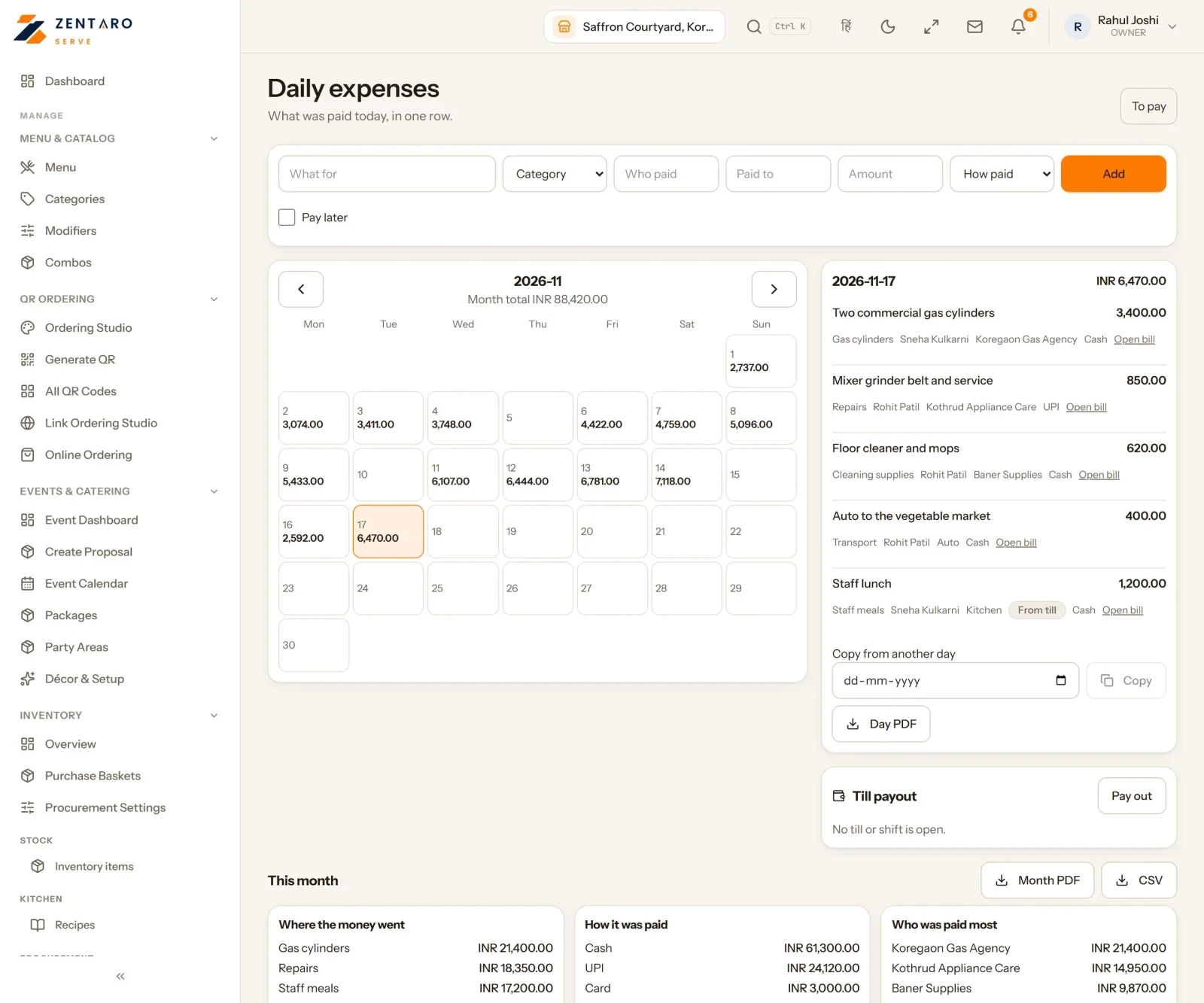
Zentaro Serve has an expenses screen for recording daily spends, and a day close that compares counted cash with expected cash. Ask us to show how the two fit together.
See payments