
Short and over: what the words mean
- Cash short means you counted less than expected.
- Cash over means you counted more than expected.
Many owners worry only about short. But over is a warning too. If the till is over, someone may have given too little change or not recorded a bill. Both mean your records and your cash disagree.
A small gap now and then is normal. A gap every night, or one that grows, needs a look.
The simple sum behind it
Expected cash is easy to state:
Opening cash + cash sales − cash paid out = expected cash
Cash paid out includes petty cash spends and refunds. Then you count the drawer and compare. The difference is the gap. Do the count before you look at the expected number, so the count is honest. This is called a blind count. The daily cash-up sheet gives a place for each number.
The usual causes of a gap
- Change errors. A guest pays ₹500 for a ₹360 bill and gets ₹40 back instead of ₹140. Busy hours make this the top cause.
- Missing bills. A bill was made, the guest paid cash, but the bill was cancelled or never saved.
- Unsettled bills. A table left, the bill was opened but never closed, and the cash went into the drawer anyway.
- Petty cash not written down. Someone took ₹200 for vegetables and forgot the slip.
- Wrong payment method. A UPI payment was entered as cash, or cash as UPI. One goes over and the other goes short.
- Float mistakes. The opening cash was counted wrongly or changed during the day.
- Tips and tip-outs. Cash tips mixed with the drawer money.
- Real loss or theft. This comes after the other causes are cleared, not before.
How to find the gap, step by step
- Count the drawer twice, ideally by two people. Write the number.
- Print or open the day's report. Note expected cash.
- Write the gap, with a plus or minus sign.
- Check the payment methods. Are UPI and card totals right against the bank or machine slips?
- List petty cash slips and refunds. Are they all entered?
- Look for open or unsettled bills.
- Look for cancelled or edited bills with cash payments.
- Check big bills in the busy hour for change errors.
- If the gap equals a bill amount, or half of it, or a round figure like ₹500, look for one specific item.
Work from the biggest likely cause to the smallest. Stop when the gap is explained.
Example: a day with a gap traced to three causes
This is an example with made-up numbers.
A 40-seat café closes on a Friday. The expected cash is ₹18,400. The drawer holds ₹17,950. The gap is minus ₹450.
| Check | Finding | Effect on gap |
|---|---|---|
| Petty cash slips | A ₹200 slip for milk was not entered | Explains ₹200 |
| Payment method | A ₹150 bill paid by UPI was entered as cash | Explains ₹150 |
| Change error | One ₹100 note given as change by mistake on a busy bill, noted by the captain | Explains ₹100 |
| Total explained | ₹450 |
The gap came down to zero unexplained. No one had taken anything. The fixes are small: enter petty cash when it is taken, choose the payment method before closing the bill, and count change back to the guest in front of them.
Without the walk through, the owner might have blamed the cashier.
Fixes that stop the gap coming back
- Blind count every night. Do it before looking at the expected number.
- Close every bill. No open bills at day end, unless you plan to settle them tomorrow, and write them down.
- Petty cash register. Record every spend with a slip. See the petty cash register article.
- Count change back. Say the amount aloud when you hand change.
- One payment method per payment. Choose it before the bill is closed.
- Lock the day. After day close, nobody edits yesterday's bills without approval.
Common mistakes
- Looking at expected cash before counting.
- Blaming one person without checking the causes.
- Letting small gaps pass for weeks.
- Not writing down the gap. Without a record, you cannot see a pattern.
- Mixing owner's cash or tips with the drawer.
A short checklist
- Did two people count the cash?
- Is the gap written with its sign?
- Are petty cash slips and refunds entered?
- Are UPI and card totals checked?
- Are there any open bills?
- Was a cause found for the whole gap?
Common questions
Why is my cash short at the end of the day?
Most often because of change errors, missing bills, petty cash not written down or wrong payment methods.
Is cash over a problem?
It can be. It means records and cash disagree. Look for missing bills or change given too low.
How much gap is normal?
A tiny gap now and then can happen. A gap every night, or a growing one, needs a look.
What is a blind count?
It is counting the drawer without seeing the expected number first. It keeps the count honest.
How do I handle petty cash in the till?
Record every spend with a slip and subtract it in the cash-up. See the petty cash register article.
Should I blame the cashier?
Not before checking the other causes. Most gaps come from small process errors.
Where Zentaro Serve fits
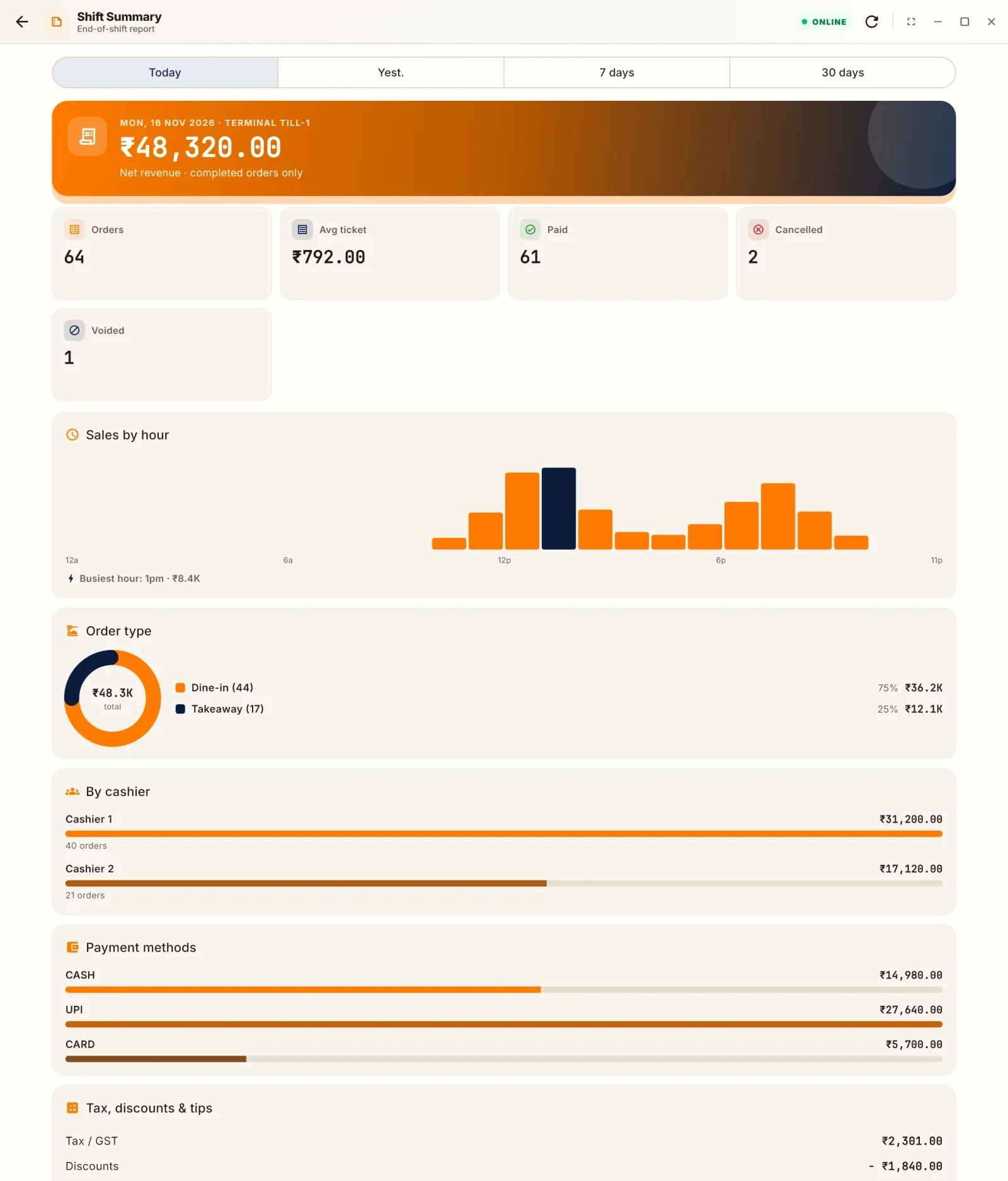
Zentaro Serve has a day close that compares counted cash to what the bills say it should be, and records each payment method on the bill. Ask us to show you a day close.
See payments