Why bills have a round-off line
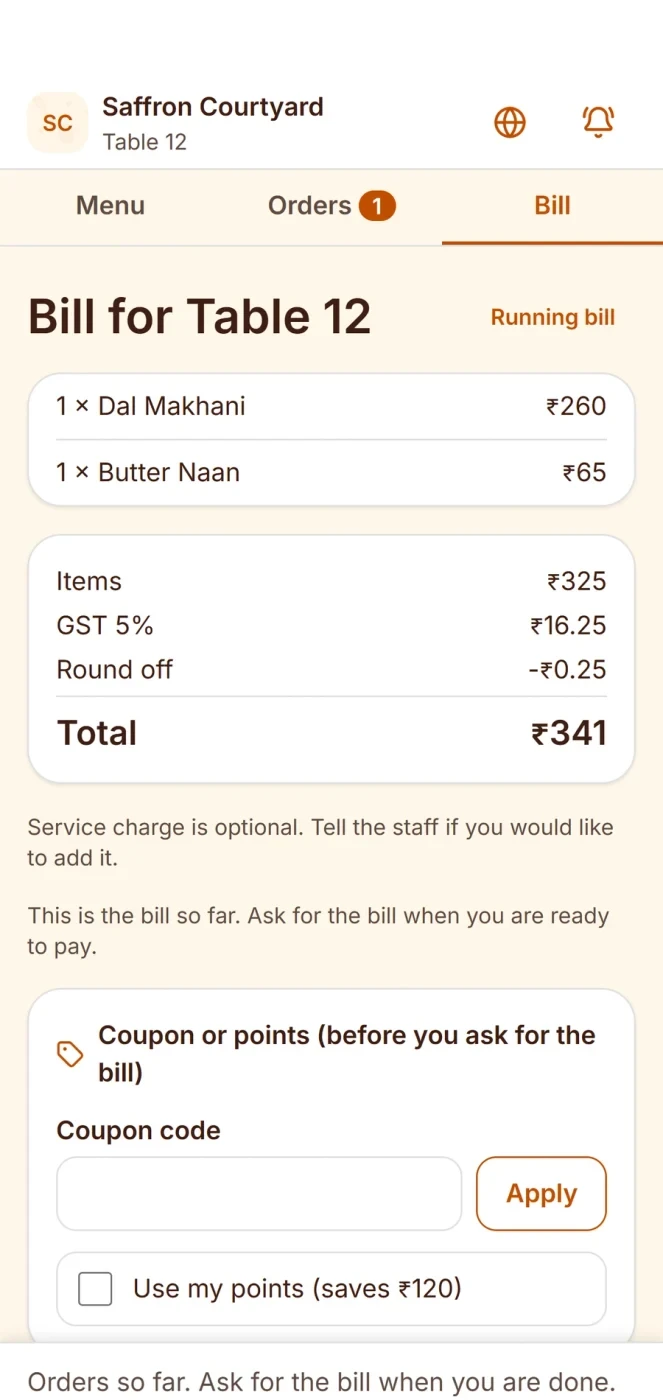
Tax is worked out to the paisa. Dishes may be priced in whole rupees, but tax on them rarely is. A bill of ₹400 with a few percent tax lands on an amount with paise.
Paying paise is awkward. Most counters do not keep coins smaller than a rupee in the drawer. So many bills round to the nearest rupee. The round-off line shows that move in plain sight, so the bill still adds up for anyone who checks it.
Where the round-off line sits
Read a bill from top to bottom and you will see this order:
- Dish lines, each with a quantity and an amount.
- A subtotal of the dishes.
- Any discount or charge.
- The tax lines. A restaurant bill may show tax in more than one line.
- The round-off line, if there is one.
- The bill total, which is the amount to pay.
The round-off comes after tax and before the final total. It is never part of the tax. It is a separate line, and it can be a plus or a minus.
Example: a bill rounded to the nearest rupee
This is an example with made-up amounts, not a real tax calculation. The tax line is shown as a plain amount.
| Line | Amount |
|---|---|
| Veg biryani | ₹220.00 |
| Paneer tikka | ₹180.00 |
| Sweet lassi | ₹60.00 |
| Subtotal | ₹460.00 |
| Tax (example amount) | ₹23.00 |
| Total before round-off | ₹483.00 |
| Round-off | ₹0.00 |
| Bill total | ₹483.00 |
That bill needs no round-off, because it is already whole. Now a second table, with a discount that creates paise.
| Line | Amount |
|---|---|
| Subtotal | ₹437.00 |
| Discount (example) | −₹43.70 |
| After discount | ₹393.30 |
| Tax (example amount) | ₹19.67 |
| Total before round-off | ₹412.97 |
| Round-off | +₹0.03 |
| Bill total | ₹413.00 |
The guest pays ₹413. The round-off line of +₹0.03 is why the total looks neat. If the total before round-off had been ₹412.40, the line would be −₹0.40, and the guest would pay ₹412.
Round up or round down?
The common habit is to round to the nearest rupee. Half a rupee or more goes up. Less than half goes down. Some places round only in one direction. This is a business choice, and the bill should show it plainly.
Rounding rules for tax invoices can be set by law and by the tax office. This is general information. Ask your accountant what your bill must follow, and see the official portal for details. A bill should not hide the round-off. It should always be a visible line.
Round-off and cash change
The round-off helps at the counter. The guest hands over ₹500 for a ₹413 bill. The change is ₹87. No coins are needed. A guest paying by UPI or card pays the same ₹413, so the amount is the same for every payment method.
Be careful with a split bill. When one bill is split three ways, each share may have its own paise. Round each share, then check that the total of the shares matches the whole bill. A gap of a paisa or two is normal and should be explained on the bill. The guide on splitting bills shows how.
How the round-off shows in your reports
The round-off is small on each bill, but it still belongs in your books. Over a month, the plus and minus lines mostly cancel out. A large net figure points to a habit: for example, always rounding up. Your sales report should show the round-off total as its own figure, so that the sales and the cash agree.
If you compare your sales report with the bank and the cash drawer, expect to see this line. A gap of a few rupees across a month is normal. A gap of hundreds is not, and deserves a look at how bills are rounded.
Common mistakes
- Hiding the round-off inside a dish price. Show it as its own line.
- Rounding before tax. Tax should be worked out first, and the round-off applied at the end.
- Mixed rounding. One waiter rounds up, another down. Pick one rule for the shop.
- Rounding every line. That can drift far from the real total. Round once, on the final amount.
- Not counting the round-off in daily totals. Over a month it adds up to a small plus or minus. Your sales report should include it.
A short checklist
- Is the round-off its own line, after tax?
- Does it show a plus or a minus sign?
- Is there one rounding rule for the whole shop?
- Does a split bill round each share and check the total?
- Does the daily report show the round-off total?
Common questions
What is round-off on a restaurant bill?
It is a small line that moves the bill to a whole rupee, so the guest pays a neat amount.
Is round-off a tax?
No. It is a rounding adjustment. It comes after the tax lines and can be plus or minus.
Do I have to round off the bill?
Many shops do, for easy change. Whether and how to round on a tax invoice is a question for your accountant.
What is the difference between paise and round-off?
Paise are the hundredths of a rupee. The round-off line removes the paise from the final amount.
Should round-off be shown on the bill?
Yes. A visible line keeps the bill honest, and anyone can check the sum.
How does round-off affect cash change?
It makes change simple. A bill of ₹413 paid with ₹500 needs ₹87 back, with no coins.
Where Zentaro Serve fits
Zentaro Serve makes the bill total for you from the dishes, charges and tax, and takes cash, card and UPI on one bill. Ask us to show you a bill line by line.
See billing software