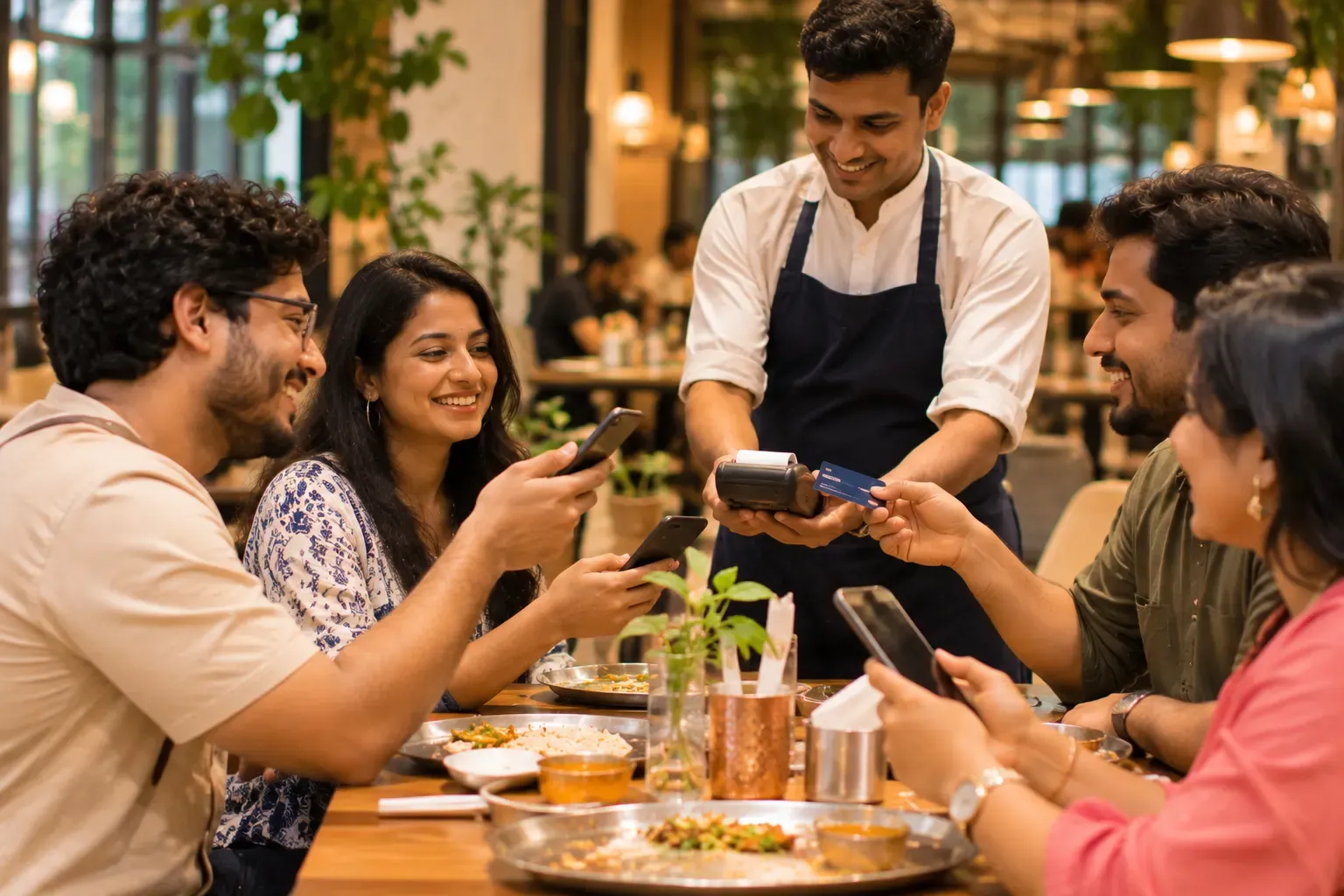
Three ways guests ask to split
Equal split. Everyone pays the same. This is the quickest. It works best when the table shared the food. The bill total is divided by the number of guests.
Split by item. Each guest pays for what they ordered. This is fair, but it takes more care. Shared dishes, like a starter for the table, must be divided too.
Split by guest. The waiter assigns dishes to guests at the time of ordering, or just before the bill. Each guest then gets a clean bill. This is the best method for a table that already knows it will split.
A fourth case is common in India. One person pays part by UPI and part by cash, or two guests pay one bill together. This is called a split tender. It means paying one bill with more than one method.
Before the bill: keep the table running
A running table is a table with an open order that grows as guests add dishes. Good habits on a running table make splitting easy.
- Ask early. "Will it be one bill or separate?" costs two seconds.
- Add dishes under the right seat or guest if you know the split in advance.
- Do not close the table until the guests confirm.
- If dishes are shared, mark them as shared when you enter them.
Step by step on the bill
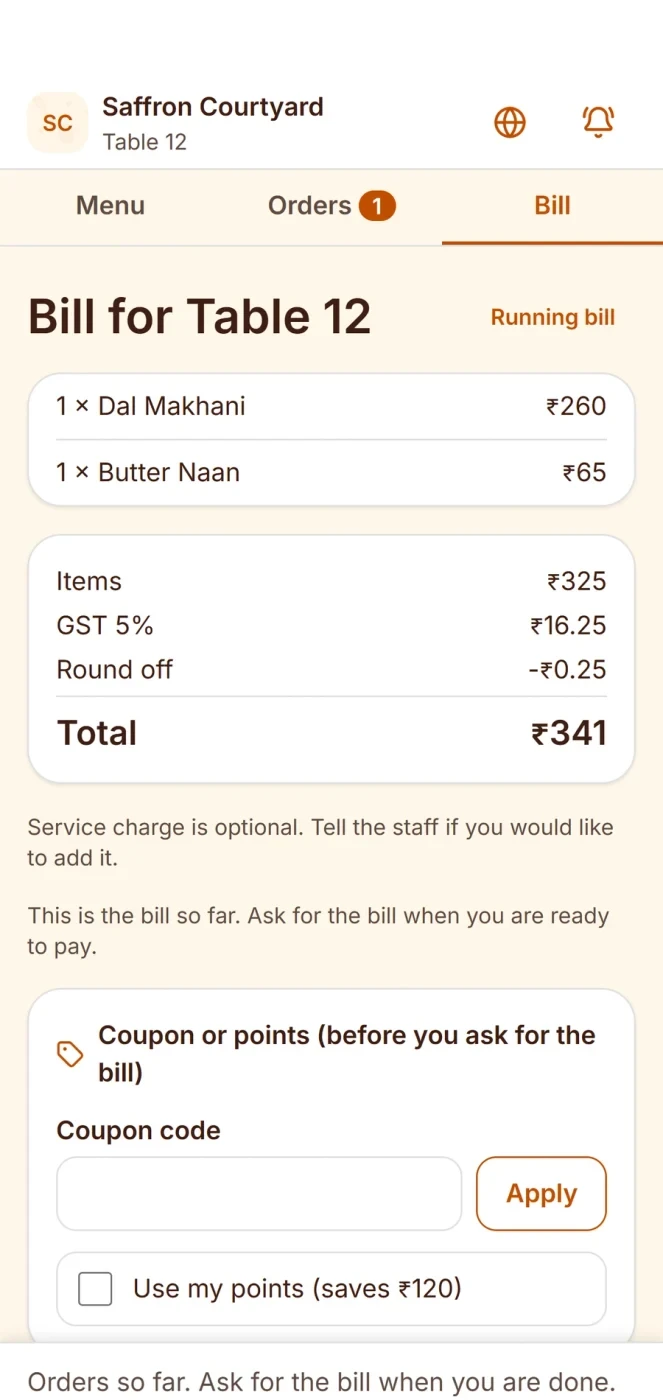
- Open the table's bill and read it back to the guests.
- Ask how they want to split.
- For an equal split, divide the total by the number of guests and make one bill per share.
- For item split, move each dish to the guest who ordered it. Divide shared dishes equally across those who ate them.
- Check that all new bills add up to the old total, including tax.
- Take each payment. Record the method on the bill. A mix of UPI and cash on one bill is common.
- Close the table only when every part is paid.
Example: a table of six
This is an example with made-up amounts. Six friends eat and the bill is ₹3,000 in total. To keep the sums easy, every amount below already includes tax.
Equal split. ₹3,000 divided by 6 is ₹500 each. Six bills of ₹500 are made. Two guests pay cash, three pay UPI, one pays by card.
Split three ways. The six friends are three couples. Each couple wants its own bill. The table had a shared starter of ₹300, which is divided into ₹100 per couple. The couples' own dishes cost ₹800, ₹650 and ₹1,250. The bills are ₹900, ₹750 and ₹1,350. Added up, they make ₹3,000. If they do not, something is missing, and you must find it before anyone leaves.
| Couple | Own dishes | Share of starter | Bill |
|---|---|---|---|
| A | ₹800 | ₹100 | ₹900 |
| B | ₹650 | ₹100 | ₹750 |
| C | ₹1,250 | ₹100 | ₹1,350 |
| Total | ₹2,700 | ₹300 | ₹3,000 |
Taxes and charges also have to be split. A good system does this for you. If you do it by hand, split the pre-tax amounts and add tax to each bill the same way you would for a normal bill.
Taxes, discounts and tips
When one bill becomes three, three things can go wrong.
- Tax rounding. Small paise differences appear when you divide a tax amount. The total of the parts may differ from the original by a paisa or two. See round off on a restaurant bill.
- Discounts. If a coupon applies to the whole table, decide how to share it. Usually it is split in the same proportion as the dishes.
- Optional tip or service line. If a guest chose to add one, agree with the table how it is shared across the parts. It is never added to a bill by default.
Common mistakes
- Closing the table before every share is paid.
- Splitting equally when guests did not share food equally, and getting an argument.
- Forgetting to split the shared dishes.
- Splitting tax by hand and getting rounding gaps.
- Not writing the payment method on each bill. The day-end totals then go wrong.
- Cash given as change from one bill is mixed up with another bill's cash.
A short checklist
- Did I ask the table early how it will pay?
- Are shared dishes marked?
- Do the new bills add up to the old total?
- Is each payment method recorded?
- Is the table closed only when all parts are paid?
Common questions
What is the easiest way to split a restaurant bill?
An equal split. Divide the total by the number of guests. It suits tables that shared the food.
How do I split a bill by item?
Move each dish to the guest who ordered it, and divide shared dishes across those who ate them. Check that the parts add up to the total.
Can one bill be paid with cash and UPI?
Yes. That is a split tender. Record each payment so the bill is fully paid and the day totals are right.
How is tax handled on a split bill?
Each part carries its own share of tax. A billing system does this for you. If you do it by hand, keep the method the same as a normal bill.
What if the parts do not add up?
Look for a shared dish that was missed, a discount that was not shared, or a rounding gap of a paisa or two.
Should a waiter ask about splitting at the start?
It is a good habit. It lets the waiter add dishes to the right guest, so the bill is easy at the end.
Where Zentaro Serve fits
In Zentaro Serve you can split a bill and take cash, card and UPI on the same bill. Ask us for a demo of a split on your own menu.
See billing software