What counts as wastage
Wastage is food you bought and could not sell. It does not include food that guests ate. Four things are usually called wastage:
- Spoilage. The item went bad or passed its date.
- Over-prep. You cooked or cut more than you sold.
- Mistakes. A dish was burnt, dropped or made wrong.
- Returns. A guest sent a dish back and it could not be reused.
Trim is different. Trim is the part of an item you cut away and never plan to serve, such as peel and bones. Trim is expected, so you handle it in your yield figure. Read our guide on yield and portion size. Write trim in the register only when it is more than normal.
The columns of a register
| Column | What to write | Why |
|---|---|---|
| Date and time | When it was thrown | Shows which shift |
| Item | The ingredient or dish | Shows what is lost |
| Quantity and unit | 2 L, 1.5 kg, 12 slices | The size of the loss |
| Reason | Spoilage, over-prep, mistake, return, other | The cause |
| Cost | Quantity times the unit cost | The money lost |
| Written by | Initials | Who to ask |
Keep it simple. A register that takes a minute to fill is used. A long one is ignored.
Where to keep it
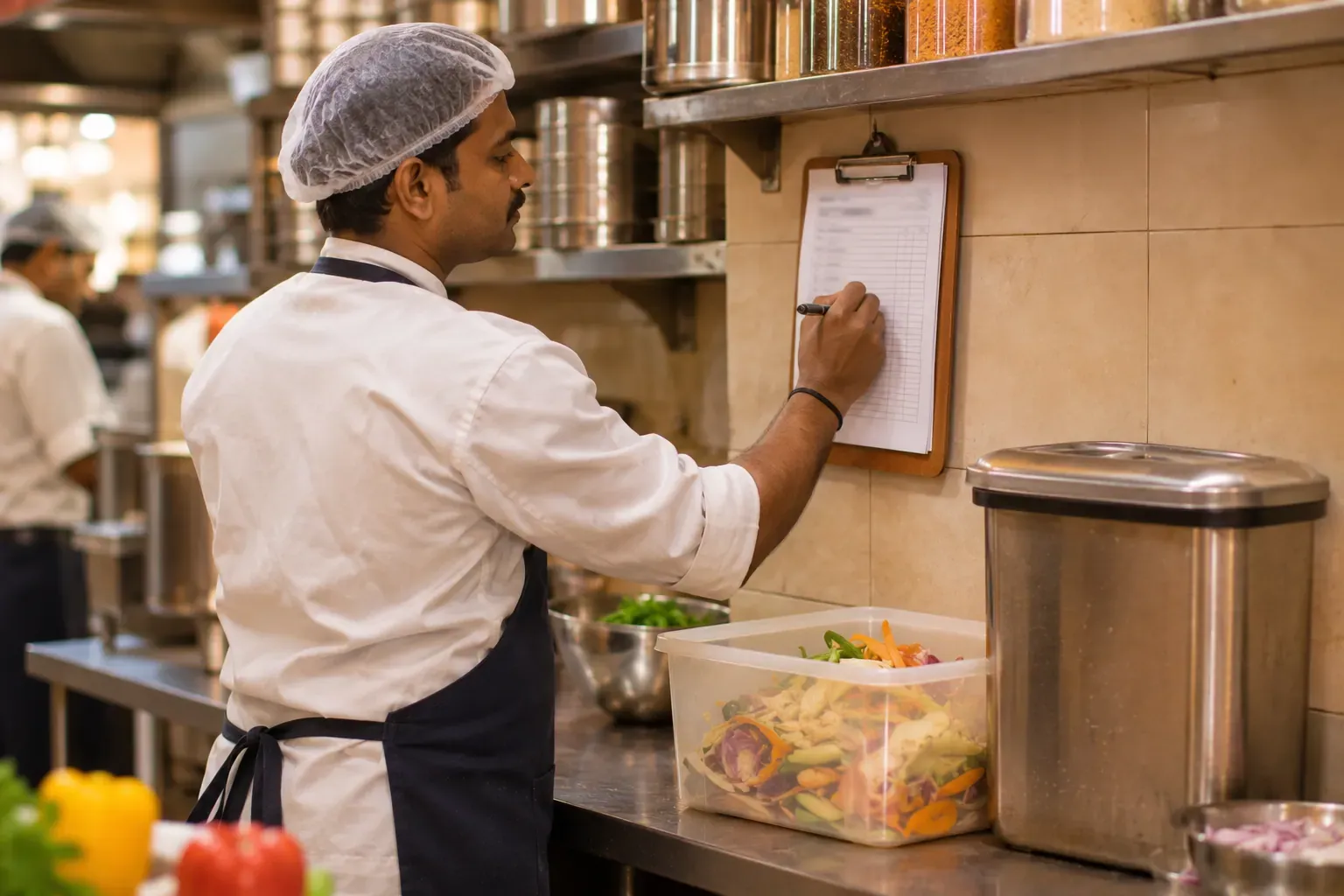
Put the register where the waste happens. A clipboard on a hook next to the bin works well. Cooks write the entry as they throw the item, not at the end of the day. Late entries are guesses.
Reasons are the key
The reason column is the most useful. Keep a short fixed list, so the sums are easy.
- Spoilage or expiry
- Over-prep
- Cook error
- Guest return
- Spill or damage
- Other
If "other" is common, your list is missing a reason. Add it.
Weekly review
Once a week, add up the cost by reason and by item. Ask three questions:
- Which reason costs the most?
- Which item appears most often?
- What one change would cut the top cause?
Our food wastage calculator can help you turn the totals into a monthly figure.
Example: one week for a cafe kitchen
This is an example, with made-up quantities and costs.
| Day | Item | Quantity | Reason | Cost |
|---|---|---|---|---|
| Mon | Milk | 2 L | Spoilage | 120 |
| Tue | Paneer | 0.5 kg | Over-prep | 200 |
| Wed | Bread | 12 slices | Cook error, burnt | 36 |
| Thu | Cooked rice | 2 kg | Over-prep | 120 |
| Fri | Cream | 1 L | Spoilage | 250 |
| Sat | Curd | 1.5 kg | Spoilage | 120 |
| Total | 846 |
By reason, the week looks like this.
| Reason | Cost | Share |
|---|---|---|
| Spoilage | 490 | More than half |
| Over-prep | 320 | A little over a third |
| Cook error | 36 | A small part |
Spoilage costs the most, and it comes from dairy. The owner looks at the dairy order. The cafe was ordering for a busy week that did not come. The fix is a smaller order, a date check on the shelf, and a look at par levels. Over-prep is second, so the cook also trims the morning rice batch. One small change per cause is enough.
Use dates to cut spoilage
Many spoilage entries come from poor rotation. Put the oldest stock in front, and label every box with its date. Our guide on FIFO and FEFO in a restaurant explains how.
Common mistakes
- Writing at the end of the day. Entries are then guesses.
- No reason. You cannot fix a cause you do not know.
- Not costing the loss. A pile of small entries can still add up to a lot.
- Counting trim as wastage. Handle normal trim in the yield.
- Never reading it. A register that no one reviews changes nothing.
A short checklist
- Is the register next to the bin?
- Does each entry have an item, quantity, reason and cost?
- Is the list of reasons short and fixed?
- Do you add it up each week?
- Does one change follow each review?
Common questions
What should a wastage register record?
The date, the item, the quantity, the reason and the cost of each item lost. Add the initials of the person who wrote it.
What is the difference between wastage and trim?
Wastage is food you could not sell. Trim is the part you cut away on purpose, like peel. Handle normal trim in the yield.
How often should I review the register?
Once a week. Add up the cost by reason and by item, and pick one change for the biggest cause.
Who should fill in the register?
The cook who throws the item, at the time. Late entries are guesses.
Why record the reason?
The reason tells you what to fix: ordering, storage, cooking amounts or training.
Where Zentaro Serve fits
In Zentaro Serve you record what you receive, count stock, and see variance and wastage, with each dish linked to its ingredients.
See inventory software