
Where the money leaks
Voids, cancels and discounts are normal. A guest changes their mind. A dish comes out wrong. A regular gets a small thank-you. The trouble starts when there is no rule and no record.
Money leaks in these ways:
- An item is voided after the guest pays, and the cash is kept.
- A bill is cancelled and a new one is made, and the first one vanishes.
- A discount is given to a friend, or to the cashier's own order.
- A bill is reprinted and used twice.
Most staff never do any of this. A few do, and only when no one checks.
Rule 1: manager approval
Anything that removes money from a bill should need a second person.
- A void after the order is sent to the kitchen needs manager approval.
- A bill cancel needs manager approval.
- A refund needs manager approval.
- A discount above a limit needs manager approval.
Give each role its own limit. A cashier may give up to a small discount. A manager may give more. Only the owner may give the largest ones. This is discount control. It keeps good will with guests and puts a ceiling on the loss.
Rule 2: a reason every time
Make the cashier pick a reason: wrong item, guest changed mind, food late, quality complaint, staff error, other. A reason makes people stop and think. Over time, the reasons also tell you what to fix.
- "Food late" many times a week points to a kitchen problem.
- "Wrong item" many times points to a menu or training problem.
- "Other" is a warning. If it is common, ask why.
Rule 3: bill reprint and duplicate bill rules
A reprint is useful when a guest loses the bill. But a reprint can also hide a second use of one bill.
- A reprint should say "Duplicate" on the paper.
- Each reprint should be recorded.
- Too many reprints on one cashier is a sign to look closer.
Rule 4: an audit trail
An audit trail is a log of who did what and when. It records the user, the time, the item and the reason for each void, cancel, discount and reprint. When a number looks odd, you can find who did it. Ask any system you use whether it keeps this log, and whether staff can edit it. They should not be able to.
Rule 5: read the report
Rules do nothing if no one checks. Once a week, read:
- Voids and cancels, by person and by reason.
- Discounts, by person and by amount.
- Reprints, by person.
Look for a person who stands out. Do not accuse. Ask, and listen. The cause may be a training gap.
Example: a week of voids by role
This is an example, with made-up numbers. A cafe reads its weekly report.
| Role | Voids | Cancels | Discounts given | Reprints |
|---|---|---|---|---|
| Cashier A | 6 | 1 | 4 | 2 |
| Cashier B | 21 | 5 | 14 | 9 |
| Manager | 4 | 0 | 8 | 1 |
Cashier B stands out on every column. That does not prove anything. It may be that Cashier B works the busy evening shift. The owner checks the reasons. Most of B's voids say "wrong item". The owner finds that evening orders come in fast, and the menu names are confusing. Training and a menu fix cut the voids. In another cafe, the same table might point to real misuse, and the owner would then act. The report did its job: it showed where to look.
Common mistakes
- One shared login. You cannot tell who did what. Give each person their own.
- A manager password everyone knows. Approval then means nothing.
- No reason field. Reports tell you little.
- Reading the report only after a loss. Read it every week.
- Accusing too soon. Check the facts first.
A short checklist
- Does every void, cancel and refund need approval?
- Is there a discount limit for each role?
- Is a reason required?
- Is a reprint marked as a duplicate?
- Does the system keep a log that staff cannot edit?
- Do you read the weekly report?
Common questions
How do I stop voids from leaking money?
Require manager approval, record a reason every time, and read a weekly report of voids by person.
What is discount control?
It means each role has a limit on the discount it can give. A bigger discount needs approval from a higher role.
What is an audit trail?
It is a log of who did what and when, for example who voided an item, with the time and reason.
Why mark a reprinted bill as a duplicate?
It stops a reprint from being used as a second bill. It also lets you count reprints.
Should every cashier have a separate login?
Yes. With a shared login you cannot tell who did what.
Where Zentaro Serve fits
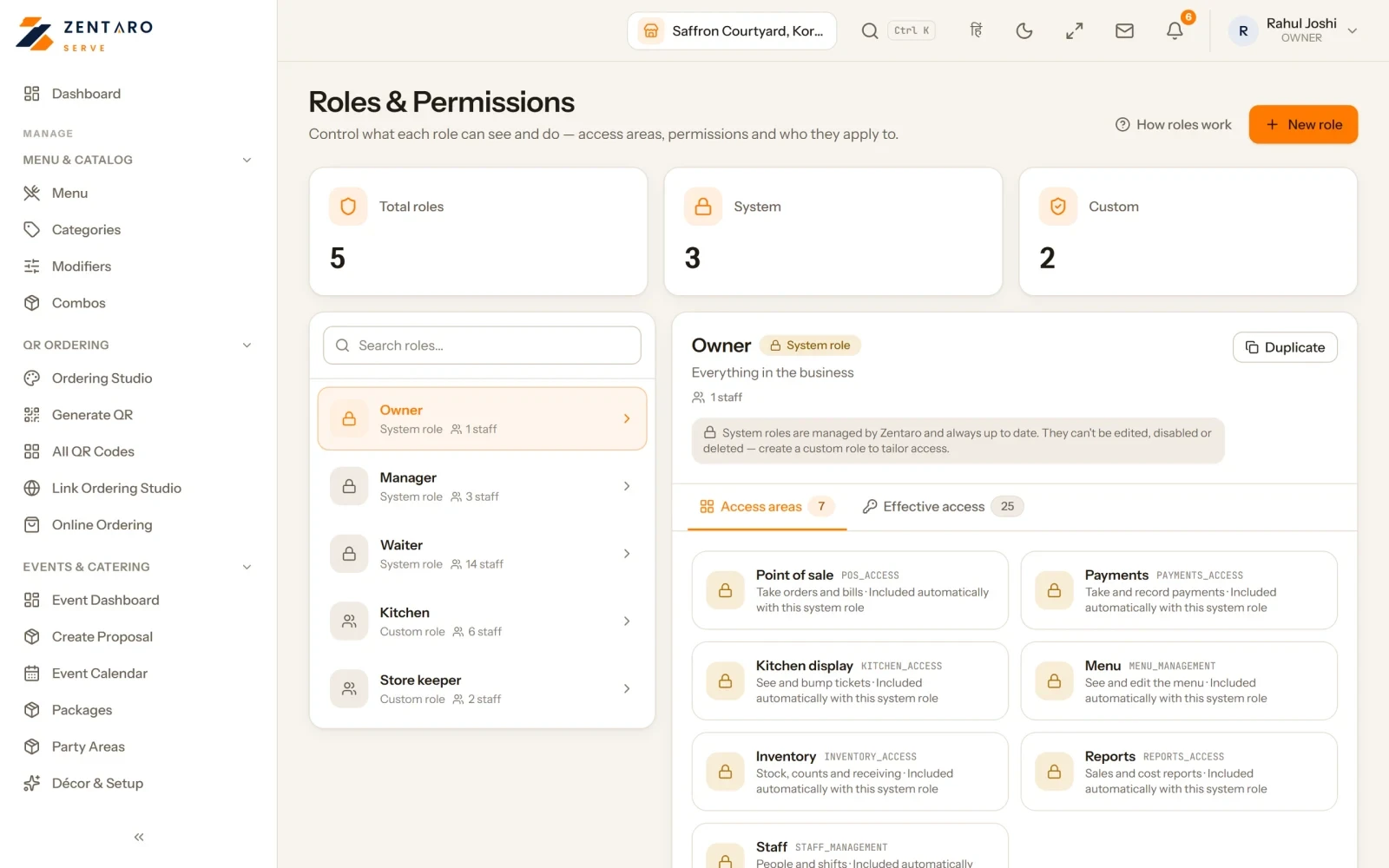
In Zentaro Serve, discounts stay inside the limit set for each role, and a void or a refund can need a second person to approve it.
See how access is controlled