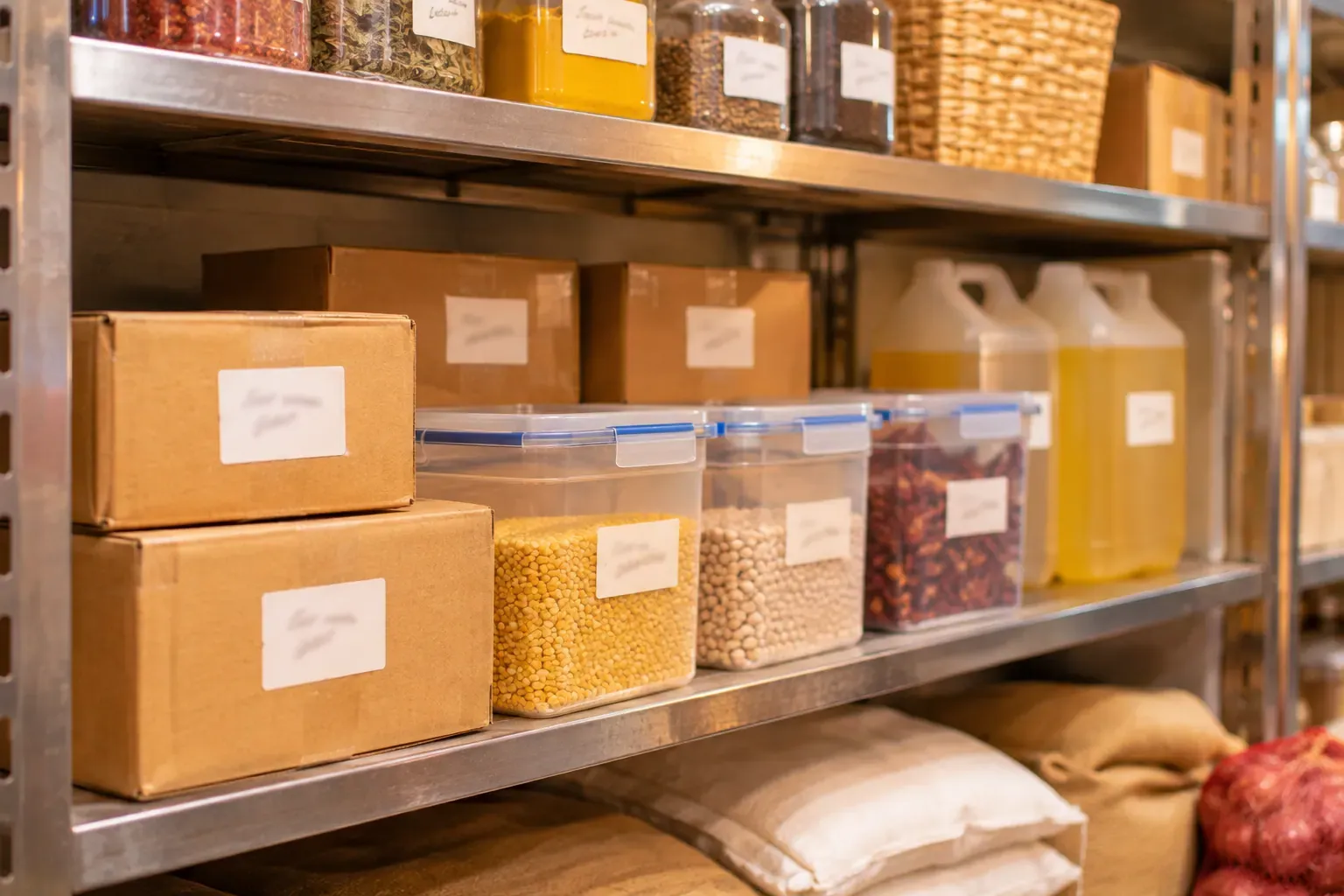
Why rotation matters
Food that sits at the back of the shelf goes off. You then throw it away, and you pay for it twice: once to buy it, once as lost margin. Rotation makes sure the stock that must go first does go first. It is one of the cheapest ways to cut wastage in a kitchen store room.
FIFO: first in, first out
With FIFO, the oldest stock is used first. The item that came in first goes out first.
- Put new stock behind the old stock.
- Take from the front.
- It works well for dry goods with long dates, such as rice, flour and tinned food.
FEFO: first expired, first out
With FEFO, the stock with the earliest expiry date is used first. The arrival date does not matter.
- Read the expiry date on each box.
- Put the earliest date at the front.
- It works well for dairy, meat, fish, fresh sauces and anything with a short date.
The two can give different answers. A newer delivery may expire before an older one. FIFO would use the old one first. FEFO would use the newer one, because it expires sooner.
Date labels
Rotation only works if you can see the dates.
- Label every opened or prepared item with the date it was opened or made, and the use-by date.
- Use a simple colour code for days of the week, if you like. For example, one colour for Monday and another for Tuesday.
- Write dates in one clear format, such as 08 Nov.
- Use waterproof labels or tape that sticks in a cold room.
Shelf layout
A good shelf layout makes rotation easy.
- Put old stock at the front or on the left. Put new stock behind or on the right.
- Keep each item in one fixed place, so cooks find it.
- Use clear containers where possible, so the dates are visible.
- Do not stack new boxes on top of old ones.
- Keep raw items below cooked items in the fridge, to stay safe.
Example: a dairy shelf with three batches
This is an example, with made-up dates. Today is 6 November. The fridge holds three batches of curd.
| Batch | Received | Expiry | FIFO order | FEFO order |
|---|---|---|---|---|
| A | 1 Nov | 8 Nov | First | First |
| B | 3 Nov | 12 Nov | Second | Third |
| C | 5 Nov | 10 Nov | Third | Second |
With FIFO, the cook would use A, then B, then C. By the time the cook reaches C on 10 Nov, C is about to expire, while B still has two days left. With FEFO, the cook uses A, then C, then B. Batch C is used before it expires, and B, which lasts longest, goes last.
In this example, FEFO is the safer rule for curd. The shelf reads left to right as A, C, B.
Which rule for which area
| Area | Examples | Rule |
|---|---|---|
| Dry store | Rice, flour, lentils, tinned food | FIFO |
| Cold room | Milk, curd, paneer, cream, meat, fish | FEFO |
| Prepared items | Sauces, marinades, cut vegetables | Date label and FEFO |
| Frozen | Frozen meat, fries | FEFO |
Dry goods usually have long dates. FIFO is simple and works. Anything that spoils quickly is safer under FEFO.
Check on a schedule
Rotation fails when nobody looks. Add a short date check.
- Once a day, check the cold room for items that expire today or tomorrow.
- Once a week, walk the dry store and check the dates.
- Move items near their date to the front, and use them in a special.
- Throw away what is out of date, and write it in the wastage register.
At the delivery door
Rotation starts when stock arrives. When you receive goods, check the expiry date on each box. Refuse items with a very short date unless you plan to use them today. Then put the new stock in the right place right away. See purchase register and supplier bills for how to record a delivery.
Common mistakes
- Putting new stock in front. The old stock then sits and expires.
- Following FIFO for short-date items. Use FEFO when dates differ.
- No label on an opened item. Nobody knows how old it is.
- A messy shelf. Cooks grab the nearest box.
- Skipping the daily date check. Items go off unseen.
A short checklist
- Is the oldest or earliest-expiry stock at the front?
- Is every opened or prepared item labelled with a date?
- Is FEFO used for short-date items?
- Is there a daily check of the cold room?
- Is waste written in a register?
Common questions
What is FIFO in a restaurant?
FIFO means first in, first out. You use the oldest delivery first.
What is FEFO?
FEFO means first expired, first out. You use the item with the earliest expiry date first.
Which is better, FIFO or FEFO?
Use FEFO for dairy, meat and short-date items. FIFO is fine for dry goods with long dates.
How should I label items in the store room?
Write the date opened or made and the use-by date on each item. Use labels that stick in a cold room.
How often should I check dates?
Check the cold room daily and the dry store weekly.