
What this audit is, and is not
This is the check an owner or manager does. It is not a statutory audit and it does not replace your accountant. It answers one question: do my numbers match what is really happening?
Do it on the same day each month. Pick a quiet time, such as the morning after month end. Use the same checklist each time, so you can compare months.
Step 1: the stock audit
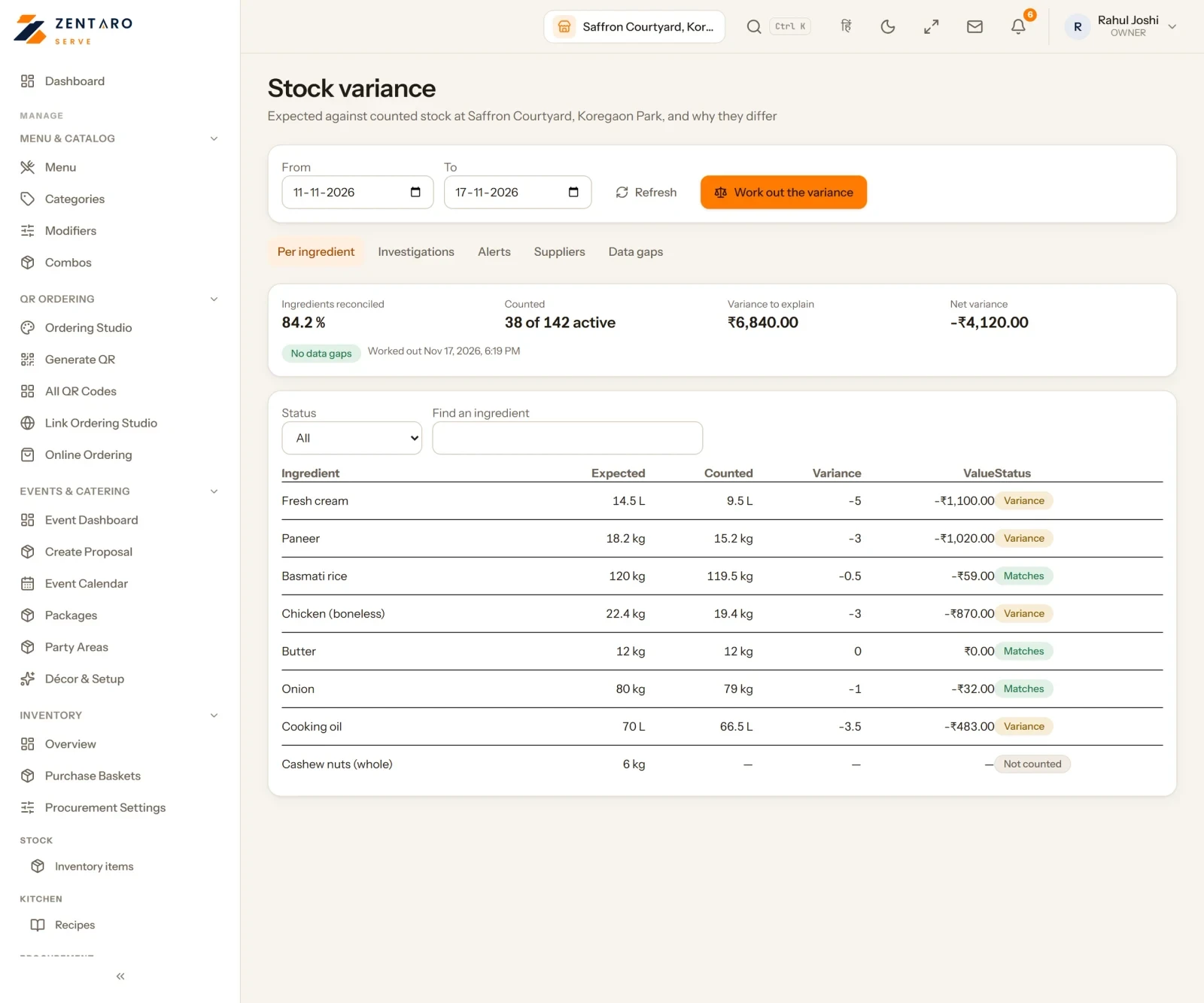
A stock audit compares the stock you should have with the stock you do have.
- Count the main items on the shelf and in the fridge. Count the high-cost items first: meat, dairy, oil, spirits if you serve them.
- Work out the expected stock: opening stock plus purchases minus usage.
- Write the variance, which is counted stock minus expected stock.
- Mark any item with a large or repeated variance.
Read the stock register guide for the format.
Step 2: the cash check
The cash check looks at the month, not just one day.
- Add up the daily cash short and over entries. Is the total near zero, or does it lean to one side?
- Check that every day was closed, with no skipped days.
- Check the petty cash register: every slip has an amount, a reason and an approver.
Read why the till does not match for common causes.
Step 3: the bills check
Pick a sample of bills and look at them closely.
- Look at voids, cancels and discounts. Who did them, and why?
- Check that bill numbers run in order, with no unexplained gaps.
- Check a few reprints.
- Compare sales by payment type with what the bank or payment app shows.
An audit trail helps here. It is the log of who did what and when. Ask your billing system whether it has one. See void and cancel control.
Step 4: expenses
Go through the expenses for the month.
- Does each have a bill or a slip?
- Are the big ones expected: rent, salaries, supplier bills, power?
- Did any cost jump? A jump can be a price change or an error.
- Are supplier bills paid or marked as due?
Step 5: write the variance list
At the end, write a short list:
- What matched.
- What did not, and by how much.
- A reason, if you know it.
- One action for each gap, and who owns it.
Keep the list. Next month, check that the actions were done.
Example: a 40-seat cafe month-end checklist
This is an example, with made-up numbers. The owner works through the list in order.
| Step | Check | Result | Action |
|---|---|---|---|
| 1 | Stock count: coffee beans | Expected 18 kg, counted 17 kg | Variance 1 kg, watch next month |
| 1 | Stock count: milk | Expected 140 L, counted 128 L | Variance 12 L, check spoilage and spills |
| 1 | Stock count: cooking oil | Expected 30 L, counted 30 L | Matches |
| 2 | Cash short and over for the month | 4 days short, 2 days over, net short 60 | Look at the shift with 3 short days |
| 3 | Voids and discounts | One cashier has more than half of all voids | Talk to the cashier, check reasons |
| 3 | Bill numbers | One gap, bill 2214 missing | Find the reason in the log |
| 4 | Expenses with no slip | 3 entries | Ask for slips, or mark as unverified |
| 4 | Supplier bills | 2 unpaid, due next week | Add to the payment list |
The result is a list of seven small actions. None is dramatic. Together they stop small leaks from becoming habits. Next month, the owner checks the milk, the missing bill and the voids first.
Use the numbers check
Our restaurant numbers check is a free tool that helps you test whether your own figures look sensible.
Common mistakes
- Auditing only when something looks wrong. A monthly habit finds problems early.
- Counting only some items. Include the high-cost items every time.
- Not writing the variance down. You cannot compare months from memory.
- Blaming first. Check the cause before you talk to people.
- Never closing the actions. A list that nobody follows up on does nothing.
A short checklist
- Stock counted and variance written?
- Cash short and over totalled for the month?
- Voids, discounts and bill numbers sampled?
- Expenses checked against slips?
- A variance list with an action and an owner for each gap?
Common questions
What is a restaurant audit?
In this guide, it is a monthly self-check of your stock, cash, bills and expenses. It compares the records with what you can see.
How long does a month-end check take?
A few hours for a small restaurant, once you have a fixed checklist.
What is variance?
Variance is the gap between what the records say and what you counted or found.
Is this the same as a tax audit?
No. This is your own check. Ask your accountant about statutory audits and tax rules.
What is an audit trail?
It is a log of who did what and when, such as who voided a bill. It helps you find the cause of a gap.
Where Zentaro Serve fits
Zentaro Serve links each dish to its ingredients, so stock leaves as you sell. You record what you receive, count stock, and see variance and wastage.
See inventory software