Why a restaurant needs a KOT
Without a ticket, an order lives in a waiter's head. Then the waiter shouts it across the pass. Shouting works on a quiet afternoon. It fails on a full Saturday night.
A KOT fixes three things:
- The cook reads the same words the waiter wrote. Nothing is lost in the shouting.
- Every dish has a time on it, so the kitchen can see which order came first.
- You get a record. If a guest says "I never ordered that", you can look at the ticket.
What goes on a KOT
A good KOT format is short. The cook should read it in two seconds. Here is the usual content.
| Field | Why it is there |
|---|---|
| Table number or order type | Tells the runner where the food goes. Use words like Dine-in, Takeaway or Delivery for orders with no table. |
| KOT number | Lets you find the ticket later. |
| Time | Shows how long the order has waited. |
| Waiter or captain name | Tells the kitchen who to call with a question. |
| Dish name and quantity | The main job of the ticket. |
| Notes and changes | For example "less spicy", "no onion" or "serve with first course". |
| Station | Shows whether the dish is for the tandoor, the wok or the cold counter. |
Notice what is missing. A KOT has no prices and no tax. The cook does not need them. Keeping prices off the slip also stops them from being seen by people who should not see them.
Example: a 30-seat family restaurant
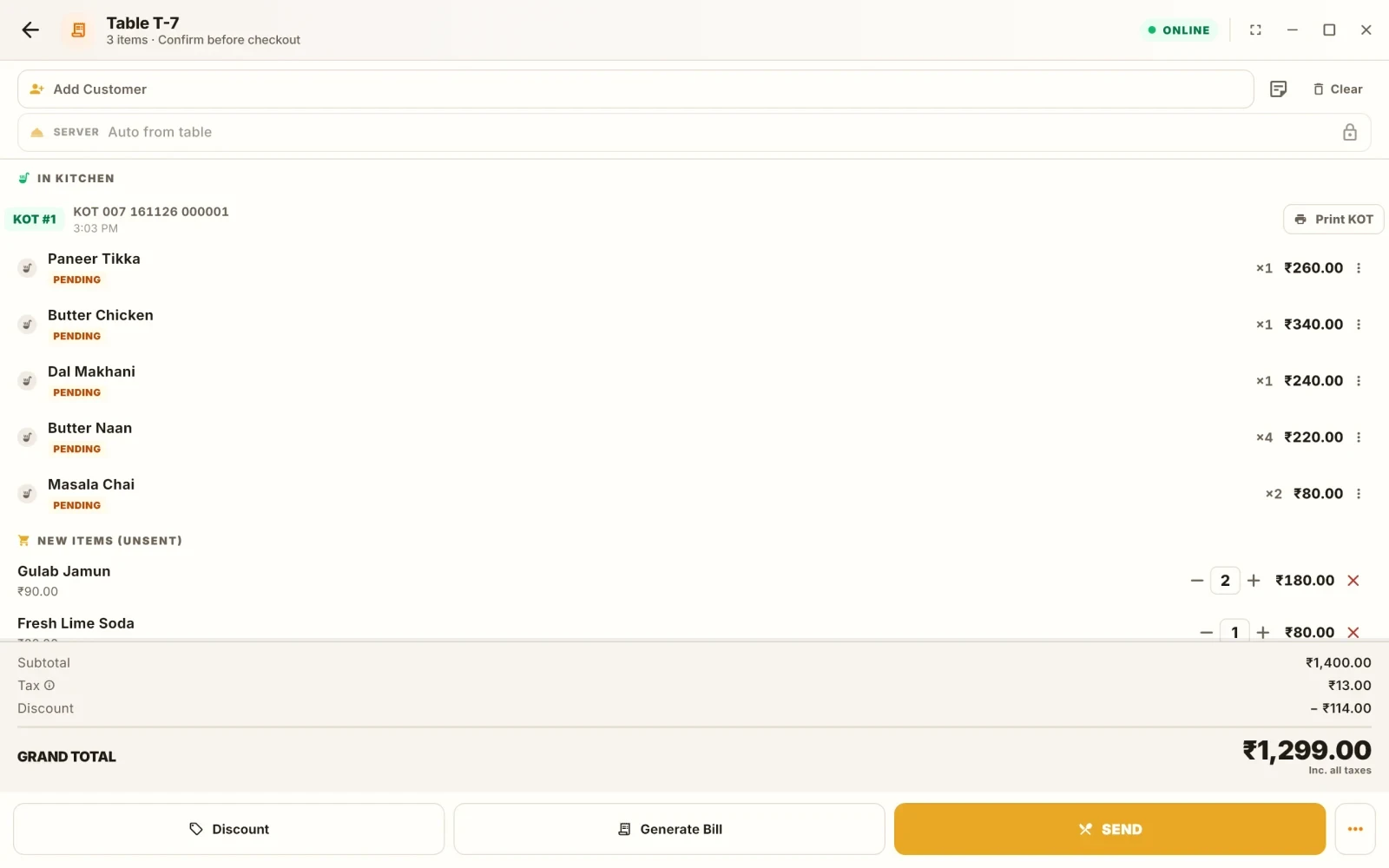
This is an example, with made-up dishes. Table 6 orders four dishes at 8:42 pm. The KOT might read like this.
| Line | Content |
|---|---|
| Header | KOT 0147, Table 6, 8:42 pm, Captain: Ravi |
| Tandoor | 1 x Paneer tikka (less spicy) |
| Main kitchen | 1 x Dal fry, 2 x Butter naan |
| Main kitchen | 1 x Veg biryani (serve after the starter) |
The tandoor cook sees only the tikka. The main kitchen sees the rest. This is called station routing. It means each cook reads only the lines that belong to them.
Later the guest asks for one more naan. That should be a new KOT with only the new item. Do not reprint the whole order. A repeat of all four dishes is how kitchens cook everything twice.
Paper KOT, printer KOT and digital KOT
There are three common ways to carry the ticket.
- Handwritten duplicate book. The waiter writes two copies and tears one off. It costs almost nothing. But handwriting is hard to read, and the copy can be lost.
- KOT printer. The till sends the ticket to a thermal KOT printer in the kitchen. The text is clear, and every ticket is numbered. A kitchen with several stations can have a printer at each one.
- Digital KOT on a screen. The ticket shows on a kitchen display. This is called a KDS, short for kitchen display system. Cooks tap a dish when it is ready, and the waiter sees the status.
Many kitchens use a printer and a screen together. The printer is the backup when a screen goes dark. If you want the longer story, read the glossary entry for KOT and the one for KDS.
KOT vs bill
People mix these up, so here is the difference in one table.
| Item | KOT | Bill |
|---|---|---|
| Goes to | The kitchen | The guest |
| Shows prices | No | Yes |
| Shows tax | No | Yes |
| Printed | When the order is taken | When the guest asks to pay |
| Can change | Yes, with a new KOT | Only through a proper edit |
A KOT is also not the same as a BOT. BOT means bar order ticket. It does the same job as a KOT, but for drinks. It goes to the bar, not the kitchen. Only a restaurant that serves drinks needs one.
Common mistakes with KOTs
- Printing the whole order again. Send only the new items.
- Writing notes on the side of the paper. If the note is not on the ticket, the cook may miss it.
- No KOT number. Without a number you cannot trace a missing ticket.
- One printer for everything. A busy kitchen needs each station to see its own dishes.
- Cancelling by word of mouth. If a dish is cancelled, the kitchen needs a cancel ticket, or the cook will make it anyway.
A short KOT checklist
- Does every ticket have a table or order type, a number and a time?
- Are notes written on the ticket, not said aloud?
- Does each station get only its own dishes?
- Is there a backup if the printer runs out of paper?
- Does a cancelled dish reach the kitchen?
Common questions
What does KOT mean in a restaurant?
KOT means kitchen order ticket. It is the slip or screen message that tells the kitchen what to cook for a table.
Is a KOT the same as a bill?
No. A KOT goes to the kitchen and has no prices. A bill goes to the guest and shows prices and tax.
Do I need a KOT printer?
Not always. A small counter can work with a handwritten book. A kitchen with many dishes and stations is easier to run with a printer or a screen.
What is a digital KOT?
A digital KOT is the same ticket shown on a screen instead of paper. Cooks mark dishes ready on the screen.
What is the difference between a KOT and a BOT?
A KOT goes to the kitchen. A BOT goes to the bar, for drinks.
Can I change a KOT after it is sent?
You cannot change what is already on the kitchen's paper. Send a new ticket with the change, and a cancel ticket for any dish you want stopped.
Where Zentaro Serve fits
In Zentaro Serve, a KOT prints on a kitchen printer or shows on a kitchen screen, or both. Each ticket goes to the right station. Ask us about your printer model before you buy anything.
See KOT software