
The idea
Running out of an item in the middle of service is costly. Holding too much ties up cash and risks spoilage. A reorder level gives you a clear line. You order when stock reaches that line, and not before.
Many people use these words in the same way:
- Reorder level and reorder point mean the stock at which you place an order.
- Minimum stock is often used for the same line. Some people mean the lowest stock you want to ever see.
- Par level is the stock you want to have after a delivery. Read about it in how to set par level.
The three inputs
You need three numbers for each item.
Daily use. How much you use on an average day. Use your stock register for the last few weeks. Use a busier number for weekends if the days differ.
Lead time. How many days pass between placing an order and receiving the goods. Ask the supplier. Count in days, and include Sunday if there is no delivery.
Safety stock. An extra cushion for a busy day or a late delivery. A common starting point is one day of use. For a key item that you cannot do without, use more.
The formula
Reorder point = daily use x lead time + safety stock
Then decide the order quantity. A simple rule is to order enough for a fixed number of days, such as five days of use.
Example: reorder point for cooking oil
This is an example, with made-up numbers. A cafe uses 6 litres of cooking oil a day. The supplier delivers in 2 days. The owner keeps one day of use as safety stock.
| Input | Value |
|---|---|
| Daily use | 6 L |
| Lead time | 2 days |
| Safety stock | 6 L (one day) |
| Use during lead time | 6 x 2 = 12 L |
| Reorder point | 12 + 6 = 18 L |
| Order quantity | 30 L (five days of use) |
Here is how it plays out. When the stock falls to 18 L, the owner orders 30 L. Over the next two days, the cafe uses 12 L. The stock drops to 6 L, which is the safety stock. Then the delivery arrives, and the stock becomes 36 L. The cafe never ran out. If the delivery is a day late, the safety stock covers it.
When the numbers change
Reorder levels are not fixed forever. Review them when:
- Sales rise or fall in a season.
- A festival or event is coming.
- The supplier changes the lead time.
- You change the menu.
- You keep running out, or you throw away stock often.
Our inventory reorder calculator can work out the numbers for you.
Items that need extra care
| Item type | How to treat it |
|---|---|
| Fresh vegetables, dairy | Short lead time, small orders, often daily |
| Dry goods | Longer lead time, bigger orders, lower risk |
| Imported or special items | Longer lead time, higher safety stock |
| Items from one supplier only | Higher safety stock, find a second supplier |
Perishable items need small orders and a tight reorder level. Dry goods can have more. Always match stock with FEFO or FIFO so older stock is used first.
Keep the register honest
A reorder level only works if your stock numbers are right. Record every delivery and count regularly. See the purchase register guide and the stock register format.
Common mistakes
- Guessing daily use. Use real numbers from the register.
- Forgetting the lead time. A slow supplier needs a higher reorder level.
- No safety stock. One late delivery then shuts a dish.
- Too much safety stock. Cash is tied up and food goes off.
- Never reviewing. The right level this month may be wrong next month.
A short checklist
- Does each key item have daily use, lead time and safety stock written down?
- Is the reorder point worked out with the formula?
- Is the order quantity set?
- Do you review levels when sales change?
- Is the stock register accurate?
Common questions
What is a reorder level?
It is the stock at which you place the next order. When the shelf falls to that level, you reorder.
How do I work out the reorder point?
Multiply daily use by lead time and add safety stock.
What is safety stock?
It is an extra cushion that covers a busy day or a late delivery. A common starting point is one day of use.
What is the difference between par level and reorder level?
Par is the stock you want after a delivery. Reorder level is the stock at which you place an order.
How often should I review reorder levels?
Review them when sales, the menu or the supplier lead time changes, and at least every few months.
Where Zentaro Serve fits
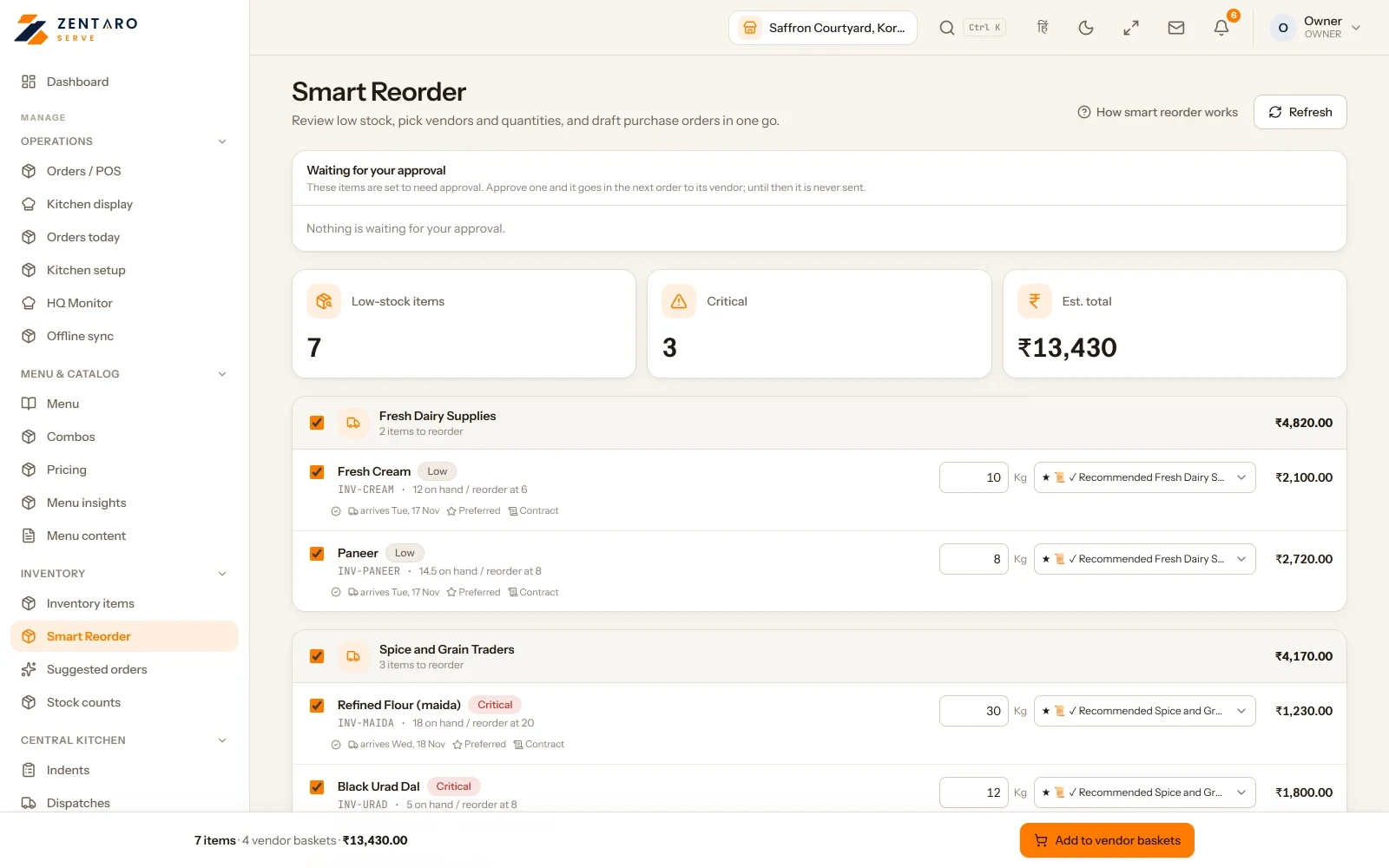
Zentaro Serve lets you record supplier bills and receive goods into stock. It suggests what to reorder and lets you compare suppliers.
See stock and purchasing